

In this article: A complete guide to recliner types, mechanisms, recline angles, materials, frame construction, and how home theater recliners differ from standard living room chairs.
- The Recliner Spectrum: From Entry-Level to Theater-Grade
- How Mechanisms Work: Manual, Single Motor, Independent Motors
- Recline Angles and What They Mean for Long Sessions
- Materials: Fabric, Bonded, Top-Grain, Italian Nappa
- Frame Construction, Wall Clearance, and Sizing
- Home Theater Recliner vs Standard Recliner: The Real Differences
- Frequently Asked Questions
Recliners span a wider range than most buyers expect — from a basic lever-operated chair under $500 to a purpose-built theater seat with independent motors, Italian Nappa leather, and integrated heat and massage over $3,000. Understanding where each type sits, what mechanism drives it, and what the materials actually mean makes it straightforward to match a recliner to its intended use.

This guide covers the full spectrum in order: types and price tiers, how the mechanisms actually work, what different recline angles do to the body over a long session, how materials compare, what frame construction and sizing mean in practice, and how a home theater recliner differs from a standard living room recliner in ways that matter for daily use.
Quick Takeaways
• Independent motors are required for true zero gravity positioning.
A single-motor recliner moves the back and footrest together; independent motors let the footrest rise above heart level while the back stays at a separate angle.
• Bonded leather is not a viable long-term material in any price tier.
It is a composite that peels within three to five years; every other material option outlasts it at comparable or lower cost.
• Wall hugger recliners need four to six inches of rear clearance versus 18 to 24 for standard recliners.
This is a mechanical difference, not a size difference — the seat base slides forward as the back reclines.
• Recline angle past 150 degrees requires a power headrest to prevent neck strain.
At shallow angles a fixed headrest is adequate; at deeper reclines the head falls back without powered neck support.
• Home theater recliners are purpose-built for extended viewing in shared environments.
Higher-density cushioning, row configurations, USB charging, and advanced lumbar support address sustained use in ways a standard living room recliner does not.
1. The Recliner Spectrum: From Entry-Level to Theater-Grade

The recliner market divides into four tiers defined by mechanism, material, and intended context of use. Understanding which tier matches your use pattern prevents both overspending and buying a chair that underperforms for your actual needs.
Entry manual ($400–$800 CAD)
Lever-operated or push-back mechanism with two to three fixed recline positions. Upholstered in fabric or bonded leather. These chairs are suitable for occasional reading or casual sitting and are not built for extended daily viewing sessions. Frame construction at this price point is typically particle board and light steel rather than kiln-dried hardwood or full steel.
Power standard ($800–$1,500 CAD)
An electric motor replaces the lever mechanism, providing smooth and continuous positioning rather than fixed stops. At this tier the recliner fits standard living room use well. Materials step up to genuine fabric or entry-grade top-grain leather. Frame construction is more durable. Power recline without a power headrest is the typical configuration at this price point.
Power luxury ($1,500–$3,000 CAD)
Full power feature set: power recline, power headrest, power lumbar, wall hugger mechanism, and in many configurations heat and massage. Upholstered in top-grain or Italian Nappa leather. Frame built to higher tolerances with motor components rated for tens of thousands of cycles. This is the tier most buyers targeting a home theater or dedicated media room should evaluate.
Theater-grade ($3,000+ CAD)
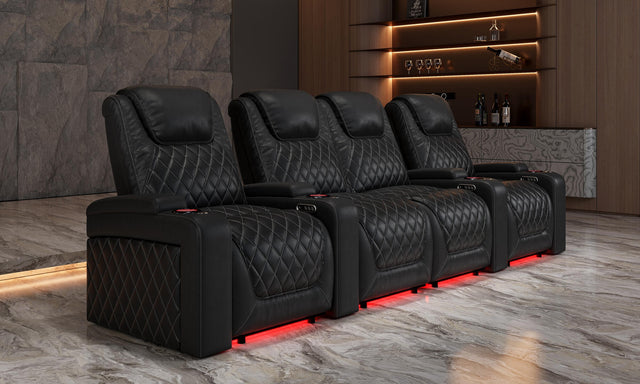
Row configurations, USB-A and USB-C charging ports integrated into the seat base or console, LED cup holders with ambient lighting, zero gravity positioning via independent motors, and top-grade Nappa leather. These seats are engineered for sustained daily use and shared viewing environments. Component tolerances and upholstery grades are at the top of the consumer market.
2. How Mechanisms Work: Manual, Single Motor, Independent Motors

The mechanism determines what positions are available, how smoothly the chair moves between them, and what features are possible. There are four distinct types.
Manual lever
A side-mounted lever releases the footrest, which rises as the occupant pushes back with body weight. The backrest reclines under body pressure and locks in place at fixed detent positions — typically two or three. To return upright, the occupant shifts weight forward and the mechanism re-latches. There is no motor, no electrical component, and no continuous positioning. The footrest and backrest always move in a fixed linked relationship.
Power single motor
One electric motor controls both the backrest recline and the footrest extension simultaneously through a linked mechanism. The chair moves smoothly between any two positions without fixed stops. The trade-off is that the backrest angle and footrest height are always linked — you cannot raise the footrest while keeping the back more upright, for example. Single-motor power recliners cover the large majority of standard use cases well.
Power independent motors
Separate motors drive the backrest and footrest independently. This is required for true zero gravity positioning, where the footrest rises above heart level while the backrest holds a different angle. Independent motors also allow a viewer to keep the back more upright while extending the footrest fully — useful for watching while eating or working. This configuration is standard in theater-grade and most premium-tier seats.
Power with memory
An optional feature added on top of independent motors: the control panel or remote can save one or more preferred positions. When two people share a seat — or the same seat is used for different activities — memory positioning allows each person to recall their preferred angle with a single button press without readjusting from scratch each session.
3. Recline Angles and What They Mean for Long Sessions

Recline angle affects spinal loading, circulation, and how comfortable a position remains over time. The three relevant positions cover different use cases.
| Position | Angle | Primary Use Case | Requires Power Headrest |
|---|---|---|---|
| Standard recline | 130–140° | Casual viewing, reading, general sitting | No — fixed headrest adequate |
| Zero gravity | ~170° | Extended sessions, circulation support, lumbar relief | Yes — head falls back without powered support |
| Full flat | 180° | Near-sleep or rest during long screenings | Yes — essential at this angle |
Standard recline (130–140 degrees)
This is the most common everyday recline angle. It reduces spinal compression compared to an upright seated position and is comfortable for sessions of one to two hours without additional support features. A fixed headrest is adequate at this angle for most adults.
Zero gravity (~170 degrees)
At approximately 170 degrees, the knees are elevated above the heart. This position distributes body weight more evenly across the seat and back surface, reduces spinal disc pressure, and supports better circulation compared to standard recline. It is the preferred position for sessions over two hours. Independent motors are required to achieve zero gravity positioning, and a power headrest is necessary to keep the neck supported at this angle.
Full flat (180 degrees)
At full flat, the seat functions like a narrow bed and is suited for extended rest during very long screenings or when a secondary viewing position is desired. A power headrest at this angle is not optional — without it the head tips back at a neck-straining angle. Full flat requires independent motors and is typically found in theater-grade configurations.
4. Materials: Fabric, Bonded, Top-Grain, Italian Nappa
Material choice affects how the seat feels, how it ages, and what maintenance it requires over its lifetime. There are four categories to evaluate.
| Material | Durability | Feel | Maintenance | Best For |
|---|---|---|---|---|
| Performance Fabric | High with protector applied | Breathable, softer surface | Vacuum regularly; reapply fabric protector annually | Warm rooms, families, pets |
| Bonded Leather | Low — peels within 3–5 years | Looks like leather initially | Not repairable once peeling begins | Not recommended for any application |
| Top-Grain Leather | High | Smooth, durable surface | Annual conditioning; wipe spills immediately | Everyday use, moderate traffic rooms |
| Italian Nappa Leather | High (grade-dependent) | Soft, breathable, fine-grained | Annual conditioning; lower grades more durable | Dedicated theater rooms, luxury configurations |
Performance fabric
Breathable and practical for warmer rooms or households where leather is not ideal. Fabric does not trap heat the way leather can during long sessions. It is more susceptible to staining than treated leather, but a fabric protector applied at purchase and reapplied annually significantly reduces that risk. Regular vacuuming with a soft brush attachment prevents dust and debris from working into the weave.
Bonded leather
A composite material made by bonding leather scraps or leather dust onto a polyurethane or fabric backing. It presents the surface appearance of leather at lower cost but lacks the structural integrity of a genuine hide. Under regular use it begins to crack and peel within three to five years, typically starting at the seat and back edges where flexing is greatest. Once peeling begins it cannot be repaired. Avoid at any price point.
Top-grain leather
The upper layer of a genuine hide after the outermost surface has been lightly sanded and finished. Durable, consistent in texture, and easier to clean than full-grain leather. It is the most practical leather option for seats used daily in moderate-traffic rooms. Annual conditioning keeps it supple and prevents drying at seams and flex points.
Italian Nappa leather
Full-grain leather processed by a specific tanning method that produces a very soft, fine-grained surface with good breathability. Graded by softness and hide quality: higher grade numbers indicate finer texture. 11K Nappa is the practical daily-use grade; 15K and 20K are noticeably softer and better suited to lower-traffic dedicated rooms. All genuine Nappa benefits from annual leather conditioning.
5. Frame Construction, Wall Clearance, and Sizing

A recliner's long-term durability is determined primarily by its frame and motor components, neither of which is visible at the point of purchase.
Frame materials
Kiln-dried hardwood resists warping and cracking over time and provides a stable base for mounting the mechanism. A steel sub-frame or full steel construction offers even higher structural rigidity and is common in theater-grade seats where the mechanism loads are higher due to independent motors and heavier component assemblies. Particle board or MDF frames, common in entry-tier chairs, are significantly less durable under repeated load cycles.
Actuator motor ratings
Power recliner motors — called linear actuators — are rated for a number of full cycles at a specified load. German-engineered actuators used in premium theater seating are typically rated to 25,000 or more full cycles at their specified load capacity. At one full recline cycle per day, 25,000 cycles represents over 68 years of use. Motor quality is one of the most consequential but least-discussed differences between price tiers.
Wall clearance: standard versus wall hugger
• Standard recliner: requires 18–24 inches of clearance between the back of the chair and the wall to recline fully.
• Wall hugger recliner: requires only 4–6 inches. The seat base slides forward as the backrest reclines, keeping the top of the chair from contacting the wall.
This is a mechanism difference, not a size difference. A wall hugger is the same footprint as a standard recliner when upright; it simply reclines differently.
Seat width and weight capacity
• Standard seat width: 22–24 inches inside the armrests.
• Big and Tall configurations: 26–30 inches inside armrests.
• Standard weight capacity: 250–300 lbs per seat.
• Big and Tall rated configurations: 350–500 lbs per seat depending on the model.
Width and weight rating affect both comfort and mechanism longevity. Operating a standard-rated mechanism at weights above its specification accelerates motor wear and can void the warranty.
6. Home Theater Recliner vs Standard Recliner: The Real Differences

A home theater recliner and a standard living room recliner are not the same product in different upholstery. They are designed for different contexts, and the differences are functional rather than cosmetic.
Context and duration of use
A standard recliner is designed for individual comfort in a multipurpose living room — reading, napping, watching television for an hour or two. A home theater recliner is engineered for sustained extended viewing, often two to three hours at a sitting, in a shared environment where multiple people occupy the space simultaneously and consistently.
Cushioning density and lumbar support
Home theater seats use higher-density foam in the seat and back cushions. Lower-density foam compresses and loses support within a year or two of daily use; higher-density foam maintains its profile over many years. The lumbar support in theater seats is typically more advanced — often power-adjustable — because sustained viewing sessions demand more precise spinal support than casual use.
Row configurations and shared-use features
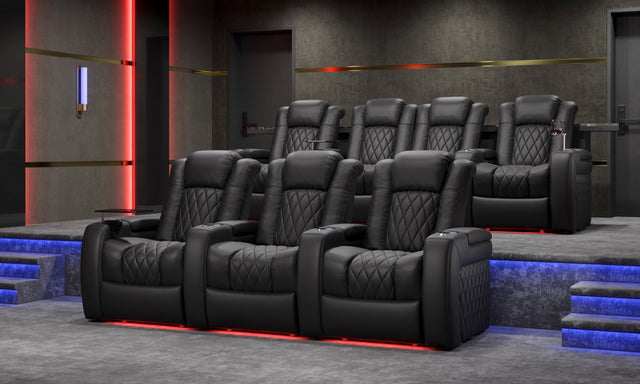
Theater recliners are available in row sections — typically two, three, or five seats connected with shared armrests and optional consoles. Row sections provide alignment between seats, a cleaner installation finish, and structural stability that individual chairs placed side by side do not replicate. Integrated cup holders, USB charging ports, and ambient LED lighting are designed specifically for the low-light, long-session context of a dedicated screening room.
Why Valencia's lineup uses power mechanisms throughout
Every seat in Valencia's lineup — from the entry Verona to the premium Tuscany Executive — uses power recline as the baseline. Manual mechanisms are a reasonable fit for occasional use in a general living room but are a meaningful compromise in a room designed primarily for viewing. Power recline with at minimum a power headrest is the practical baseline for a purpose-built home theater regardless of budget tier.
Price premium reflects engineering, not branding
The price difference between a standard power recliner and a theater-grade seat reflects the actuator motor quality, cushioning density, leather grade, additional power features (headrest, lumbar), and the structural engineering required for row configurations. Each of those components has a direct effect on how the seat performs over five to ten years of daily use.
Frequently Asked Questions
What is the difference between a single-motor and a dual-motor recliner?
A single-motor recliner uses one actuator to move the backrest and footrest simultaneously in a fixed relationship — as the back reclines, the footrest extends proportionally. A dual-motor or independent-motor recliner uses separate actuators for the backrest and footrest, so each can be positioned independently. Independent motors are required for zero gravity positioning — raising the footrest above heart level while keeping the back at a shallower angle — and are the standard configuration in theater-grade seats.
Is bonded leather a reasonable choice for a recliner at any price point?
No. Bonded leather is a composite made by bonding leather scraps onto a synthetic backing. It visually resembles genuine leather at purchase but begins to crack and peel at flex points within three to five years under regular use. Once delamination starts it cannot be repaired. Performance fabric or genuine top-grain leather both outlast bonded leather at comparable or lower total cost over five years. Avoid bonded leather regardless of the price tier it appears in.
Can a wall hugger recliner really be placed directly against a wall?
Nearly. A wall hugger mechanism requires four to six inches of clearance between the back of the seat and the wall — not zero, but close. The mechanism works by sliding the entire seat base forward as the backrest reclines, so the top of the chair never moves backward toward the wall. Standard recliners require 18 to 24 inches of rear clearance for the same full recline. If your room layout places the first row within 18 inches of the back wall, a wall hugger is required.
What does zero gravity positioning actually do for the body?
At approximately 170 degrees with the knees elevated above the heart, body weight is distributed more evenly across the contact surface rather than concentrated at the seat base and lower spine. This reduces intervertebral disc pressure in the lumbar region and supports better venous circulation in the lower legs. The position is beneficial for extended sessions because it reduces the cumulative spinal loading that occurs in standard recline over two or more hours. A power headrest is required to maintain neck support at this angle.
How do I know if a recliner's motor quality is good before I buy?
Ask for the actuator motor's rated cycle count at specified load. German-engineered linear actuators used in quality theater seating are rated to 25,000 or more full cycles at the rated weight capacity. At one full recline cycle per day, that is over 68 years of rated use. Manufacturers who do not disclose motor specifications or warranty the motor separately from the upholstery are typically sourcing lower-grade components. Motor failure is the most common long-term failure mode in power recliners, so this specification is worth asking about directly.
What seat width do I need for comfortable use?
Standard theater seats measure 22 to 24 inches inside the armrests. This fits most adults comfortably for extended sessions. If you are looking for more width — either for comfort or to accommodate a larger frame — Big and Tall configurations measure 26 to 30 inches inside armrests and are rated for 350 to 500 pounds depending on the model. Sitting in a seat that is too narrow causes armrest pressure on the thighs over long sessions, which affects circulation and comfort.
Does a home theater recliner need professional installation?
Individual seats do not require professional installation — they arrive assembled or in minimal assembly requiring no tools beyond what is included. Row sections with shared armrests and integrated consoles benefit from professional placement to ensure alignment and stability, particularly when placed on a raised riser. USB and LED wiring in theater-grade row sections requires routing to a power source, which an electrician or experienced installer handles cleanly. For a simple single-row freestanding installation, most buyers complete it without professional help.
How does Italian Nappa leather differ from regular leather?
Nappa leather is full-grain leather processed using a specific tanning method that preserves the natural grain and produces a fine-textured, soft, breathable surface. Standard top-grain leather is sanded and finished to a more uniform surface, which makes it more durable and consistent but less soft. Italian Nappa grades used in theater seating range from 9K (durable, practical) to 20K (very soft, best suited to low-traffic rooms). The main practical differences for a theater seat are breathability during long sessions and the tactile feel of the surface — both noticeably better in Nappa than in standard top-grain.


