

In this article: Our top sauna picks for 2026...
- What type of home sauna is best in Canada?
- How much does a home sauna cost in Canada?
- Indoor vs. outdoor: how to decide
- What to look for when buying (including wood types)
- Choosing the right size
- Sauna benefits: what the evidence supports
- Maintenance and care
- Frequently Asked Questions
For most Canadian homes, an indoor infrared sauna is the simplest way to start: it runs at lower temperatures than a traditional sauna, warms up faster, and many models plug into a standard household outlet. Outdoor and traditional (Finnish-style) saunas can be a great fit too, but they typically require more planning around electrical work, site prep, and permits.
This guide focuses on what matters in Canada: winter performance, electrical considerations, realistic operating costs by province, wood selection, indoor vs. outdoor trade-offs, and what to look for so you don't end up with a unit that disappoints after the first season.
Quick Takeaways
- Infrared is the easiest entry point for many homes: lower-heat experience, faster warm-up, and often 120V plug-in (model-dependent).
- Traditional electric and many outdoor builds often need a 240V dedicated circuit and professional installation.
- Operating cost depends on wattage, session length, frequency, and your provincial electricity rate—use the simple calculator below.
- Outdoor saunas can work in Canadian winters, but insulation, door seals, and correct heater sizing matter more than marketing claims.
- If you care about EMF, adhesives, or materials, ask for third-party documentation and safety details—don’t rely on vague “low” claims.
1) What type of home sauna is best in Canada?
At a glance: sauna types compared
| Infrared (indoor) | Traditional electric | Outdoor barrel/cabin | |
|---|---|---|---|
| Typical heat range | 45–65°C | 70–100°C | 70–100°C |
| Warm-up time | 10–20 min | 30–60 min | 45–75 min |
| Electrical | Often 120V plug-in | Usually 240V dedicated | Usually 240V + outdoor run |
| Moisture | Dry heat | Dry + optional steam (löyly) | Dry + optional steam |
| Installation complexity | Low | Moderate | High |
| Typical unit price (CAD) | $1,500–$5,000 | $2,500–$8,000 | $4,000–$15,000+ |
Unit price only, excludes electrical work, delivery, and site prep.
Infrared saunas (indoor)
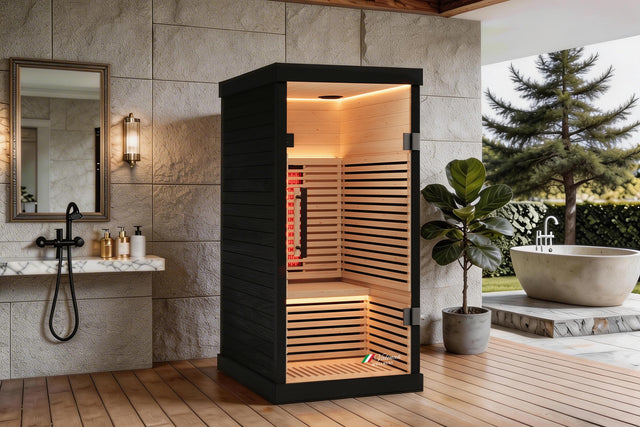
Infrared saunas use infrared light to create heat that warms your body directly. Many people prefer them because they can feel effective at lower air temperatures than a traditional sauna.
Why many Canadians start here:
- Installation can be simpler (many are designed for 120V plug-in; always confirm the requirements for the specific model).
- Faster warm-up than many traditional setups.
- Lower moisture load indoors compared with steam-heavy traditional sessions (still ventilate the room, but you’re typically not dealing with the same steam intensity).
Evidence check (plain-English): Mayo Clinic notes that infrared saunas can produce effects similar to moderate exercise (like increased heart rate and sweating) at lower temperatures, and that research is ongoing regarding specific health conditions. Larger, more precise studies are still needed for many claims. Source: Mayo Clinic – “What is an infrared sauna? Does it have health benefits?”
Traditional (Finnish-style) saunas
Traditional saunas heat the air (often with an electric heater and rocks). This is the classic high-heat, optional steam (löyly) experience many people associate with sauna culture.
What changes in Canada:
- Electrical work is more common (often 240V; confirm heater specs and local electrical code requirements).
- Indoor moisture management matters: ventilation, finishes, and (in some builds) drainage planning.
- Warm-up time is usually longer than infrared.

Outdoor saunas
Outdoor saunas can be used year-round in Canada, but winter performance depends on build quality and setup—not just “it’s rated for outdoors.”
What to prioritize for Canadian winters:
- Insulation and tight seals (doors, corners, and any glass areas are common heat-loss points).
- Weather-ready exterior materials and proper roof/water management.
- Heater sizing that matches the sauna volume and your cold-weather reality.
- Safe electrical planning (many outdoor electric saunas require a 240V run; trenching or long runs can add cost).

2) How much does a home sauna cost in Canada (without guesswork)?
Instead of giving you a “one-number” answer, here’s the structure to budget correctly.
Upfront costs to consider
- Sauna unit / kit (varies widely by size, materials, and type)
- Delivery (threshold vs. in-home placement vs. white-glove assembly)
- Electrical (possible 240V circuit, panel capacity, distance from panel, trenching for outdoor runs)
- Site prep (outdoor base/pad, drainage, weather protection)
- Permits (outdoor structures may require a building permit depending on your municipality and the size/foundation)
What operating costs actually look like across Canada
Electricity rates vary significantly by province. Using the same usage pattern (1.3 kW unit, 45-minute sessions, 16 sessions per month), your monthly cost ranges from less than a dollar to over two dollars:
| Province | Approx. rate ($/kWh) | Monthly cost (example) |
|---|---|---|
| Quebec | ~$0.061 | ~$0.72 |
| Manitoba | ~$0.096 | ~$1.13 |
| BC | ~$0.102 | ~$1.20 |
| Ontario | ~$0.103–0.182 (TOU) | ~$1.22–$2.14 |
| Alberta | ~$0.14 (variable) | ~$1.65 |
| Saskatchewan | ~$0.166 | ~$1.95 |
| Nova Scotia | ~$0.18 | ~$2.12 |
| PEI | ~$0.20 | ~$2.35 |
Approximate residential averages as of 2025. Use your utility bill rate for an accurate estimate.
This is why Quebec buyers often describe operating costs as negligible, while buyers in Atlantic Canada face meaningfully higher running costs for the same usage pattern.
Simple operating cost calculator (use your numbers)
Monthly electricity cost ≈ (Sauna wattage in kW) × (hours per session) × (sessions per month) × (your $/kWh rate)
Example: 1.3 kW × 0.75 hours × 16 sessions/month × $0.15/kWh = $2.34/month
Note: Electricity rates vary by province and by plan (time-of-use, tiered, etc.). Use your utility bill rate for the best estimate.
3) Indoor vs. outdoor in Canada: how to decide

Choose an indoor sauna if…
- You want simpler installation and fewer weather variables.
- You prefer shorter warm-up time and quick sessions.
- You have a spare room/basement area with reasonable ventilation.
Choose an outdoor sauna if…
- You want a separate “ritual space” away from the house.
- You prefer traditional high-heat + steam experiences.
- You can budget for site prep + electrical + possible permits.
The key trade-off is convenience vs. experience. Indoor infrared saunas tend to get used more frequently because access is immediate. Outdoor traditional saunas often deliver a more immersive experience but require more from the budget and the infrastructure.
4) What to look for when buying a sauna in Canada
Wood species: what actually matters
Wood selection affects how a sauna feels to use, how it holds up over years of heat cycling, and whether it works for people with scent or chemical sensitivities. The four most common options:
Western Red Cedar
- Aromatic, the distinctive cedar scent is appreciated by most buyers, but worth considering if you're sensitive to strong odors
- Naturally moisture-resistant and dimensionally stable under repeated heat cycling
- Benches stay relatively cool to the touch (low thermal conductivity), a comfort advantage
- Premium price point; the most common interior wood in Canadian saunas
Hemlock (Western or Canadian Hemlock)
- Neutral scent, the practical choice for people who find cedar too strong or have resin sensitivities
- Pale color, smooth grain, takes heat cycling well
- Widely used in infrared saunas; slightly more affordable than cedar
Basswood
- Very light color, nearly odorless, very low resin content
- Popular for infrared saunas among buyers with allergies or chemical sensitivities
- An affordable entry point; widely available in entry-level and mid-range units
Nordic Spruce
- Traditional Finnish sauna wood; pale, fine-grained appearance
- Generally affordable; common in European-style and entry-level traditional builds
- Less inherently moisture-resistant than cedar, consistent ventilation and maintenance matter more
Practical note: For any wood species, ask about the adhesives and finishes used in construction. If you're sensitive to VOCs or off-gassing, request documentation, not just a "low chemical" or "non-toxic" marketing claim.

Electrical & safety clarity
- Get exact electrical requirements in writing (120V vs 240V, amps, dedicated circuit needs).
- If the sauna is outdoors, confirm weather-rated components and safe routing for any electrical runs.
If you care about “low EMF” claims
There is no single universal consumer standard that every brand follows consistently. If EMF is a priority, ask for third-party testing documentation with measurement distance and methodology specified. Vague marketing terms ("ultra-low," "near zero") are not a substitute for actual test data.
5) Choosing the right sauna size
Matching size to how you'll actually use the sauna prevents the most common mistake: buying too small (cramped, regrets within months) or too large (slower warm-up, space and cost you don't use).
1-person sauna (~91 × 122 cm / 36" × 48")
- Best for solo use, small spaces, and daily wellness routines
- Fastest warm-up; lowest operating cost per session
- Fits in most spare rooms, large bathrooms, or finished basement corners
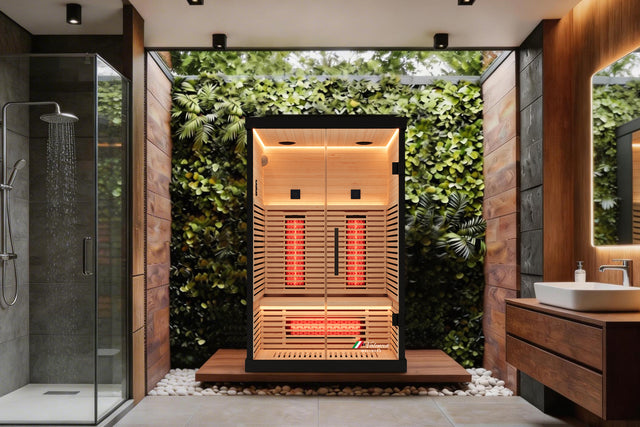
2-person sauna (~120 × 120 cm / 47" × 47"), most popular
- Ideal for couples, or for solo buyers who want room to stretch out or lie down
- The most flexible choice for households that aren't sure: large enough to share, efficient enough for solo use
- Most Canadian buyers default here when undecided, and rarely wish they'd gone smaller
3-person and larger (~152 × 152 cm / 60" × 60" and up)
- Good for families or shared wellness spaces
- Requires more floor area and a longer warm-up
- Often requires 240V even for infrared models at this capacity
Tip: If you're deciding between a 1-person and 2-person, most buyers who choose the 1-person report wishing they'd gone larger after a few months of regular use.
6) Sauna benefits: what the evidence supports, and what it doesn't
Many Canadians use saunas for relaxation, stress reduction, post-exercise recovery, and a consistent winter wellness routine. Here's the honest picture on the research.
Reasonably well-supported:
- Cardiovascular response. A large Finnish prospective study (Laukkanen et al., JAMA Internal Medicine, 2015) found that men who used a sauna 4–7 times per week had significantly lower rates of fatal cardiovascular and all-cause mortality compared to once-weekly users, an association that held after controlling for physical activity, smoking, and other lifestyle factors. The study population was traditional Finnish sauna users; results may not transfer directly to infrared sauna use.
- Moderate exercise-like effects. Infrared saunas can produce elevated heart rate, increased sweating, and temporary vasodilation at lower air temperatures than traditional saunas. Mayo Clinic describes these effects as comparable to moderate exercise. Source: Mayo Clinic
- Muscle relaxation and perceived recovery. Heat exposure supports muscle relaxation and is commonly used by athletes as part of a recovery protocol. The subjective benefit is widely reported; the clinical evidence varies by specific condition and population.
Where the evidence is thinner:
- Claims about detoxification, significant weight loss, immune system modulation, or treatment of specific chronic conditions are either not well-established or based on small preliminary studies. Larger clinical trials are needed before these claims can be made with confidence.
If you have health concerns: Cardiovascular conditions, pregnancy, blood pressure medications, or conditions that affect heat tolerance, consult a qualified healthcare professional before starting regular sauna use.
Not medical advice.


