

In this article: A practical guide to finding a recliner that actually fits larger frames — covering dimensions, weight ratings, frame construction, and how to verify fit before you order.
- Why Standard Recliner Specs Fall Short for Larger Frames
- The Dimensions That Actually Determine Fit
- Weight Capacity: What the Ratings Mean in Practice
- Frame and Mechanism Requirements for Long-Term Durability
- Features That Improve Comfort for Big and Tall Users
- How to Choose and Order the Right Configuration
- Frequently Asked Questions
Most recliners are built around a narrow target user. When you fall outside that range — taller, broader, heavier, or some combination — a chair that looks comfortable in photos or feels acceptable in a five-minute showroom test can become genuinely uncomfortable over the course of a two-hour film. The issues are specific and measurable: seat width that compresses the hips, seat depth that leaves thighs unsupported past the knee, a headrest that ends at shoulder height, a footrest that stops at mid-calf. Each one is solvable, but only if you know what to look for and what the specs actually mean.

This guide works through the specs that actually determine fit for big and tall users — not the marketing language, but the specific measurements, construction details, and feature requirements that separate a chair you can sit in comfortably for three hours from one that leaves you shifting position every twenty minutes.
Quick Takeaways
• Seat width is the first filter.
Big and tall recliners should offer 26–30 inches between armrests. Standard chairs at 21–24 inches cause hip compression that worsens over long sessions.
• Weight capacity should have margin, not just coverage.
If your weight falls within 20% of the rated maximum, the mechanism will wear faster. Aim for a model rated at least 50–75 lbs above your weight.
• Power headrest is the most important upgrade for tall users.
It tilts the top of the seat forward to meet your neck, effectively extending the headrest range by 3–4 inches without requiring a taller overall chair.
• Foam density determines long-term support.
40-lb density foam or above supports larger body mass without bottoming out over months of use. Most standard chairs use lower-density foam that compresses permanently.
• Footrest length is consistently underspecified.
Standard footrests end at mid-calf for legs over 36 inches. Look for 18–22 inch footrest extension or a chaise-style configuration that eliminates the gap entirely.
1. Why Standard Recliner Specs Fall Short for Larger Frames

Standard recliners are engineered around a user profile that concentrates on roughly 5'8"–5'11" and 180–220 lbs. That range covers a portion of the population well. Outside of it, the fit degrades in specific, predictable ways — and each problem compounds over time.
What Happens at the Edges of Standard Specs
When a seat is too narrow, the armrests press into the outer hip and thigh. At 20 minutes this reads as mild discomfort. At 90 minutes it becomes genuine pain in the hip flexors and outer thigh, and many users unconsciously shift their weight or lean to one side, which introduces lower back strain.
When seat depth is insufficient, the front edge of the cushion cuts into the back of the thigh rather than supporting it. Thighs that hang unsupported past the knee restrict circulation and cause the familiar leg numbness that prompts seat-shifting. A seat that is 2–3 inches too shallow creates this problem for users with longer thigh-to-knee measurements.
When the headrest doesn't reach the neck, users lean their head forward or tilt it back at an unnatural angle to find support. Over a two-hour session this produces neck and upper shoulder fatigue. For users above 6'1", a fixed headrest on a standard chair often ends at upper shoulder height rather than neck height.
When the footrest is too short, heels rest on the end of the footrest rather than being fully supported, and the calf muscle bears load against the footrest edge. This isn't painful immediately, but over a full evening it produces calf fatigue and foot discomfort that standard-sized users never encounter.
Why the Problem Compounds Over a Theater Session
Small fit issues that feel tolerable at 20 minutes become painful at 90 minutes. The body compensates for poor fit — leaning, shifting, adjusting posture — and those compensations fatigue the muscles doing the corrective work. A chair that passes a brief showroom test can still fail badly for a full evening of viewing. The only reliable way to evaluate fit is to understand the measurements and compare them to your own body dimensions before purchasing.
2. The Dimensions That Actually Determine Fit

These are the six measurements that determine whether a recliner actually fits a larger body, what the difference between standard and big and tall spec looks like in practice, and why each one matters.
| Dimension | Standard | Big & Tall | Why It Matters |
|---|---|---|---|
| Seat width (between armrests) | 21–24 inches | 26–30 inches | Hip clearance without compression |
| Seat depth | 19–22 inches | 24–26 inches | Thigh support past the knee |
| Headrest height | Fixed or limited tilt | Power headrest with full tilt range | Neck support at varied recline angles |
| Weight capacity | 250–300 lbs | 350–500 lbs | Mechanism longevity |
| Footrest length | 14–16 inches | 18–22 inches | Heel-to-ankle support |
| Total reclined depth | 60–65 inches | 70–76 inches | Full-body flat recline |
How to Measure Seat Depth Against Your Body
Seat depth is the distance from the back of the seat cushion to the front edge. To know what depth you need, sit on a firm, flat chair and measure from the back of your thigh (where it meets the seatback) to just behind the back of your knee. That measurement is your minimum seat depth requirement. A seat shallower than this will cut into the back of your knee rather than supporting your thigh fully.
How to Assess Footrest Length
Sit in a standard upright position and note where the footrest ends relative to your ankle. If it ends more than 4 inches short of your ankle, the footrest is inadequate for extended viewing. Your heel will hang off the edge, and your calf muscles will bear load against the footrest lip rather than resting on a supported surface.
Why Power Headrest Is the Most Valuable Upgrade for Tall Users
A power headrest doesn't just raise the headrest — it tilts the top portion of the seatback forward toward your neck. This effectively extends the headrest reach by 3–4 inches without requiring a physically taller chair. For users between 6'1" and 6'4", it's the difference between genuine neck support and a headrest that sits below the base of the skull. For users above 6'4", it remains valuable but should be combined with a chair that has a higher overall back height.
3. Weight Capacity: What the Ratings Mean in Practice

Weight capacity is a safety-critical specification. It is not a soft guideline or a marketing figure. It determines whether the mechanism, frame, and motors will perform reliably over years of use — or wear out prematurely.
Why Operating Near the Rated Limit Causes Accelerated Wear
A mechanism operating near its rated capacity experiences significantly higher friction, motor load, and frame stress than the same mechanism with comfortable margin. This is true for every moving component: the actuator motors, the reclining tracks, the footrest linkage, and the frame joints. Operating at 90–100% of rated capacity for regular daily use will shorten the effective life of those components — sometimes by years.
The practical recommendation is straightforward: if your weight is within 20% of the stated capacity, look for a model with a higher rating. A 300-lb-rated chair is a reasonable choice for users up to roughly 240 lbs. It is not adequate for users at 280 lbs or above who intend to use the chair daily.
What 400–500 lb-Rated Models Include That Standard Models Don't
Higher-capacity models aren't just standard chairs with a different sticker. They include reinforced steel frame construction, higher-torque actuator motors, wider footrest base attachments that distribute load more evenly, and broader armrest attachment points that resist lateral flex under higher loads. Each of these is a physical design difference, not a paperwork difference.
The Right Question to Ask Any Seller
Ask specifically: "What is the weight capacity this chair has been tested and certified to — not the claimed maximum, but the tested rating?" Some manufacturers list aspirational maximums. You want the tested, certified figure, and ideally the test standard it was certified against. A seller who can answer that question is a seller who understands their product.
4. Frame and Mechanism Requirements for Long-Term Durability

The frame and mechanism determine how the chair holds up under load over years, not how it looks or feels on day one. For big and tall users, this is where the difference between a well-built chair and an adequate-looking chair becomes apparent.
Frame Material and Base Construction
Kiln-dried hardwood frames perform well in standard-weight applications. For higher-load use — users at or above 280 lbs — a steel frame base is the better choice. Steel doesn't expand and contract with humidity changes the way wood does, and the weld points at high-stress joints maintain their integrity under repeated heavy loading better than wood-joint alternatives.
Frame joint construction matters regardless of material. Mortise-and-tenon joints or corner-blocked construction distribute load across a larger surface area and multiple connection points. Staple-and-glue assembly concentrates stress at smaller contact points and is more prone to joint failure under sustained heavier loads.
Motor Specification
German-engineered linear actuator motors rated to 25,000 cycles or more at their rated load are the benchmark for quality in power recliners. Cycle rating at rated load is the critical figure — a motor might be rated to 50,000 cycles at a light load but fail much earlier when regularly operated near its weight limit.
For users near or above 300 lbs, ask specifically about the motor duty rating at 350 lbs or above. Some manufacturers rate the overall chair at a higher capacity than the motors are designed to handle continuously. This mismatch is a common source of motor failure in chairs that were otherwise well-built.
What to Look for When Evaluating Build Quality
Ask for the frame material specification. Ask for the motor brand and cycle rating at rated capacity. Look for a manufacturer that can answer these questions without hesitation. Vague answers — "it's a high-quality motor" without specifics — indicate that the seller doesn't know or doesn't want to share the actual spec.
5. Features That Improve Comfort for Big and Tall Users

Beyond the baseline dimensions and structural specs, certain features make a measurable difference in comfort for users outside the standard size range. These aren't luxury add-ons — for big and tall users, several of them are functional necessities.
Power Headrest
Already covered in the dimensions section, but worth repeating: power headrest is the single most important feature upgrade for tall users. It tilts forward to meet your neck at whatever recline angle you choose, rather than requiring you to find a position where a fixed headrest happens to align with your neck. For users above 6'1", a chair without power headrest will frequently fail to provide neck support at preferred recline angles.
Power Lumbar
Fixed lumbar support is positioned at a height that suits average-sized users. For taller users, that height is often too low to support the actual lumbar curve. For shorter users, it can land too high. Power lumbar adjusts vertically and in depth, allowing it to meet your lower back where it actually is rather than where a standard user's lower back would be. This is particularly relevant for users above 6'0" and below 5'6".
Extended Footrest or Chaise Configuration
For users with legs over 36 inches, a standard footrest leaves a gap between ankle and footrest end that must be bridged by the calf muscle. Over a full evening this produces calf fatigue and circulation restriction. An extended footrest in the 18–22 inch range closes this gap. A chaise-style configuration — where the support extends from hip to heel as a single continuous surface — eliminates it entirely and is the preferred option for users with leg measurements above the standard range.
Higher-Density Foam
Foam density is measured in lbs per cubic foot. Standard furniture foam runs 1.5–2.5 lbs/cu ft. Higher-quality seating foam runs 3.0–4.0 lbs/cu ft or above. For larger body mass, higher-density foam is necessary to prevent the cushion from compressing permanently over months of use — a process called foam fatigue. A cushion that bottomed out feels exactly like sitting on a thin pad over a hard surface, and it happens gradually enough that users often don't notice until the chair has already degraded significantly.
Wide Armrests
Armrest width is rarely listed in specifications but is noticeable in use. Standard armrests are 1.5–2 inches wide and are adequate for average-sized arms. For larger forearms, a 3–4 inch padded armrest provides full-surface support rather than a narrow ridge. This matters most during long viewing sessions where arms remain resting for extended periods.
6. How to Choose and Order the Right Configuration

The decision process for big and tall theater seating is straightforward once you have your measurements. This is the sequence to follow before placing an order.
Step-by-Step Fit Verification
• Step 1: Measure your seated hip width. Sit on a firm, flat chair and measure from your left hip to your right hip at the widest point. Add 2 inches minimum for comfort clearance. That total is your minimum required seat width between armrests.
• Step 2: Measure your seated thigh depth. Sitting with your back against the seatback, measure from the back of your thigh to the back of your knee. Compare this to the chair's stated seat depth. The seat depth should meet or exceed your measurement.
• Step 3: Confirm your weight is below 80% of the chair's stated weight capacity. If you weigh 280 lbs, the chair should be rated to at least 350 lbs.
• Step 4: Verify the power headrest range covers your height. Ask the seller what the maximum effective headrest height is with the power headrest fully extended. This should meet or exceed your ear height when seated.
• Step 5: Ask for the footrest extension measurement in inches. Confirm it is at least 18 inches. If your legs are above 36 inches from hip to heel, ask about chaise configuration availability.
Theater Room Configuration Considerations
For theater rooms with multiple seats, the standard recommendation is 4 inches of lateral clearance between neighboring seats. For big and tall users, 6 inches is the more comfortable guideline. This affects how many seats fit in a given row width and should be factored into the room plan before ordering. Ordering a row that's too tight to sit in comfortably side-by-side defeats the purpose of upgrading to properly fitted seating.
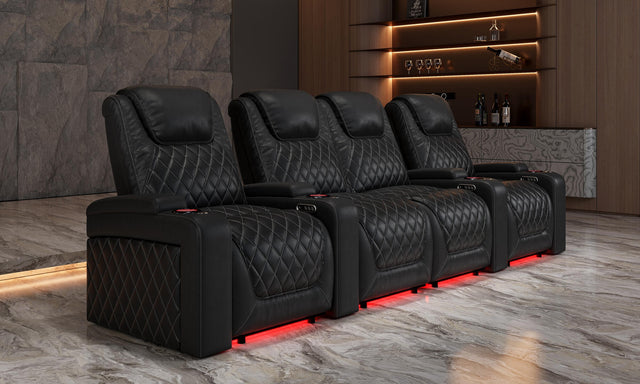
If you're ordering for a home theater installation and need guidance on configuration for your specific room dimensions, the product pages linked below include seating specifications that can be compared directly against the measurements above.
Frequently Asked Questions
What seat width is considered big and tall for a recliner?
A big and tall recliner seat width is generally 26–30 inches measured between the armrests. Standard recliners typically measure 21–24 inches. To determine what you need, measure your seated hip width at the widest point and add 2 inches minimum. If the resulting number exceeds 24 inches, you should be looking at big and tall specifications.
How important is the weight capacity rating for long-term use?
Weight capacity is critical for long-term durability. Operating near the rated limit increases friction and motor load significantly, accelerating wear on the mechanism, actuators, and frame joints. The practical guideline is to keep your weight below 80% of the stated capacity. A chair rated at 350 lbs is appropriate for users up to about 280 lbs for daily home theater use. Users closer to or above the stated limit will see accelerated degradation of moving parts.
Do power headrests work for users over 6'4"?
Power headrests extend effective reach by tilting forward 3–4 inches, which helps users in the 6'1"–6'4" range significantly. For users above 6'4", a power headrest remains useful but should be evaluated alongside the chair's overall back height. Ask the seller for the maximum effective headrest height with the power headrest fully extended and compare it to your seated ear height to confirm adequate coverage.
Is a chaise configuration better than a standard footrest for tall users?
For users with legs over 36 inches, a chaise configuration provides meaningfully better support than a standard footrest. A standard footrest leaves a gap between ankle and support surface for longer legs. A chaise-style seat extends support as a continuous surface from hip to heel, eliminating that gap entirely. For users with average-length legs, a properly sized extended footrest (18–22 inches) may be sufficient.
Can Valencia theater seating accommodate users over 300 lbs?
Yes. Valencia offers models with weight capacities in the 400–500 lb range, including reinforced frame construction and higher-torque actuator motors to match. Users over 300 lbs should look at models with this higher capacity rating rather than standard models, as operating at the upper limit of a 300-lb-rated chair will produce accelerated wear. Contact Valencia directly to confirm which current models carry the appropriate capacity for your use case.
How do I measure if a recliner will fit me before buying?
Measure four things: seated hip width (add 2 inches for minimum seat width), seated thigh depth from back to knee (this is your minimum seat depth), your weight versus stated capacity (stay below 80%), and your seated ear height versus the chair's stated headrest height with power headrest extended. These four measurements will catch the majority of fit problems before purchase. Also ask for the footrest extension length in inches and compare it to your lower leg length.
Does foam density matter for heavier users?
Foam density matters significantly for heavier users. Low-density foam compresses permanently over time — a process called foam fatigue — at a rate that scales with the load applied. Standard furniture foam at 1.5–2.5 lbs/cu ft will show noticeable compression loss within months of regular use at higher body weights. Foam at 3.5–4.0 lbs/cu ft or above maintains its support profile much longer. Ask the manufacturer for the foam density specification, not just a description like "high-density" without a number.
What is the difference between a wider seat and a wider overall chair frame?
Seat width — measured between the armrests — is the usable sitting surface. Overall chair width includes the armrests themselves. A chair with a 24-inch seat width might have an overall frame width of 30–32 inches. When evaluating fit, always use the seat width (between armrests) figure, not the overall frame width. When planning room layout, use the overall frame width to determine how much floor space each chair occupies.


