

In this article: Low-EMF in an infrared sauna isn’t about fear—it’s about smart engineering, honest measurements, and knowing what to ask before you buy...
- Far Infrared Sauna Panels Explained: Heat Distribution, Warm-Up Time, and Comfort
- Infrared Sauna Ventilation: What Homeowners Need to Know
- Infrared Sauna Materials Guide: Wood, Glass, Heating Panels, and Long-Term Durability
- Indoor Infrared Sauna Placement Guide: Flooring, Wall Clearance, Moisture, and Electrical Access
- What Is a Full-Spectrum Infrared Sauna? Benefits, Features, and Home Wellness Guide
- Benefits of Okoume Wood / Hemlock Interior
- Low-EMF Infrared Sauna: Why It Matters
- Frequently Asked Questions
A low EMF infrared sauna matters because it helps minimize unnecessary electromagnetic field exposure while you’re sitting close to electrical components—without sacrificing the calm, even heat that makes infrared sessions so comfortable. The goal isn’t perfection or panic. It’s clear, verifiable design choices (wiring layout, shielding, grounding, power supplies, and quality controls) that keep EMF levels lower where your body actually is during a session.
If you’re shopping in the wellness category, “low-EMF” is often a trust question as much as a feature request. Below, you’ll find a careful explanation of what EMF means in saunas, how claims are typically measured, and how to evaluate a model with confidence—especially if you’re comparing options in Valencia’s Wellness Series.
Quick Takeaways
• “Low-EMF” should be backed by measurement details (distance, location, meter type, and whether it’s electric and/or magnetic fields).
• Distance changes everything: EMF can drop quickly as you move away from a source, so seat-level readings matter most.
• Magnetic fields (mG) and electric fields (V/m) are different; reputable brands clarify which one they’re reporting.
• Panel layout, wiring paths, grounding, and power supplies are common reasons one sauna measures lower than another.
• Ask for a measurement map, not a single number; “lowest” is less helpful than “low where you sit.”
Far Infrared Sauna Panels Explained: Heat Distribution, Warm-Up Time, and Comfort
Far infrared panels are designed to deliver gentle, enveloping warmth that many people find easier to enjoy than hotter, more intense styles of heat. For most home users, comfort comes down to three practical outcomes: how evenly the heat surrounds you, how long the sauna takes to feel “ready,” and how consistent the experience stays across the session.

Heat distribution: why panel placement matters
Infrared warmth is directional. Panels positioned on the back, sides, and near the legs help reduce “hot spots” and make the cabin feel balanced. A well-planned layout can also help you use a lower cabin temperature while still feeling deeply warmed—useful if you prefer a calmer, more breathable session.
Warm-up time: what to expect at home
Infrared saunas typically warm faster than traditional sauna rooms because the panels begin emitting infrared energy quickly. That said, “warm-up time” isn’t only about air temperature—it’s also about surfaces and your own comfort. A thoughtful panel configuration often feels ready sooner because you’re receiving heat where your body is, not only heating the air volume.
How panels relate to EMF
Panels are part of the EMF conversation because they’re powered by electricity and contain wiring and electrical connections. Two saunas can use “far infrared panels” and still measure differently depending on the wiring design, grounding, shielding, and where electrical components are routed relative to the bench.
If you’re comparing models, it’s reasonable to ask: Where are the power supplies and wiring harnesses located? A low EMF infrared sauna design aims to keep higher-emission components farther from your seated position and reduce emissions through smart engineering—not through vague marketing language.
Infrared Sauna Ventilation: What Homeowners Need to Know
Ventilation is one of the most overlooked parts of a great home sauna experience. The right airflow supports comfort, helps manage humidity, and keeps the cabin feeling fresh—especially during longer sessions.

What “good ventilation” looks like in a home infrared sauna
• Fresh air exchange: Small, purposeful vents help prevent the cabin from feeling stuffy.
• Moisture management: Even infrared sessions create perspiration and humidity; airflow helps the interior dry out more easily afterward.
• Temperature stability: Proper vent placement can maintain a steady, comfortable feel without dramatic drafts.
Does ventilation affect EMF?
Ventilation itself doesn’t typically drive EMF levels. However, fans and electronic controls can contribute to EMF depending on motor type, wiring, and placement. If a brand markets a low EMF infrared sauna, it’s fair to ask whether measurements were taken with the sauna operating normally (lights on, controls active, any fans running), and where those components are located relative to the seat.
Infrared Sauna Materials Guide: Wood, Glass, Heating Panels, and Long-Term Durability
A home sauna should feel like a personal sanctuary—quiet, clean, and built to last. Materials influence not just longevity, but also smell, maintenance, and the day-to-day experience of stepping inside.
Wood: stability, comfort, and aroma
Quality sauna woods are chosen for dimensional stability and comfort at elevated temperatures. You want wood that resists warping and cracking, feels pleasant against the skin, and holds up through repeated heating and cooling cycles. The finish should be clean and appropriate for sauna use (typically avoiding heavy chemical coatings inside the cabin).
Glass: thickness, fit, and sealing
Glass doors and panels can elevate the look and openness of a home sauna. For durability and comfort, pay attention to fit and sealing—drafts and rattles can take away from that calm, refined experience. A well-built door also helps the sauna warm consistently.
Heating panels: construction quality matters
Not all infrared panels are built the same. Panel quality can influence how evenly heat is emitted and how reliably the sauna performs over time. If you’re evaluating a low EMF infrared sauna, panel construction also matters because internal wiring, connectors, and routing choices can affect measurable EMF near the bench.
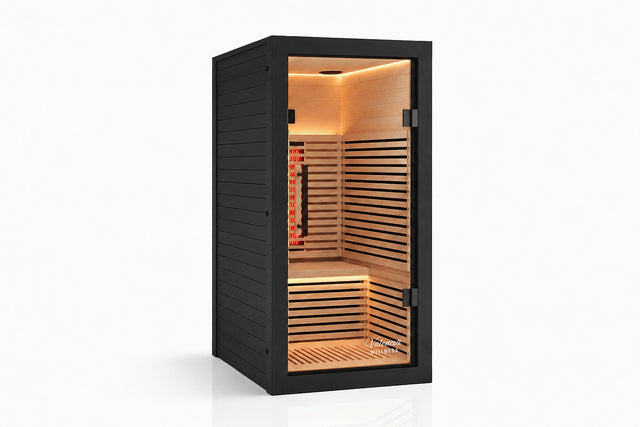
Indoor Infrared Sauna Placement Guide: Flooring, Wall Clearance, Moisture, and Electrical Access
Placement is about more than “does it fit.” A thoughtful install helps your sauna feel stable, run efficiently, and stay beautiful over years of use.
Flooring: choose a stable, level surface
Most homeowners place an indoor infrared sauna on hard, level flooring such as tile, vinyl, sealed concrete, or other stable surfaces. If you’re placing it on wood flooring, consider protection from perspiration drips and routine cleaning. Stability matters because small shifts can affect door alignment and long-term wear.
Wall clearance: give the sauna space to breathe
Plan modest clearance around the unit so air can circulate and so you can access panels or electrical connections if service is needed. Clearance recommendations vary by model, so it’s worth confirming the manufacturer’s guidance before delivery.
Moisture and nearby environments
Even though infrared saunas are often “drier” than steam environments, humidity still builds inside during use. Choose a location that allows the sauna to dry out between sessions. If the sauna is placed in a basement or other humid area, consider a dehumidifier for the room itself.
Electrical access: keep it simple, safe, and serviceable
Because an infrared sauna uses electrical heating panels and controls, you want a dedicated, properly rated circuit that matches the sauna’s requirements. For a low EMF infrared sauna, correct electrical installation also matters for performance and safety. When in doubt, work with a qualified electrician to ensure grounding and circuit specifications align with the manufacturer’s guidance.
What Is a Full-Spectrum Infrared Sauna? Benefits, Features, and Home Wellness Guide
A full-spectrum infrared sauna generally refers to a sauna that provides multiple infrared wavelength ranges—commonly near infrared (NIR), mid infrared (MIR), and far infrared (FIR). The appeal is flexibility: you can tailor sessions toward the type of heat experience you prefer and the routine that fits your day.
How full-spectrum differs from far infrared-only
• Far infrared: Often associated with a gentle, deeply comfortable warmth for longer, steady sessions.
• Near and mid infrared: Typically described as more intense or direct, depending on the emitter type and placement.
Full-spectrum and “low-EMF”: separate questions
Full-spectrum describes what wavelengths are delivered; low EMF describes how the electrical system is engineered. You can find full-spectrum models that are not particularly low-EMF, and far infrared models that are carefully engineered for low EMF. The best approach is to evaluate both: the heat experience you want and the measurement transparency you can verify.
If you’re browsing Valencia’s Wellness Series, you can start by exploring the collection and narrowing by the experience you want at home: shop the Wellness Series.
Benefits of Okoume Wood / Hemlock Interior
The interior wood choice shapes how your sauna looks, feels, and holds up over time. Two popular options you’ll see across the category are Okoume and Hemlock—each offering its own character and practical strengths.
Okoume: refined look and a calm feel
Okoume is often chosen for its smooth appearance and lighter, contemporary aesthetic. In a wellness space, that visual calm matters. It can make the sauna feel like a natural extension of a refined home interior rather than a utilitarian box.
Hemlock: steady performance and everyday durability
Hemlock is commonly selected for stability and a clean, understated look. Many homeowners like it because it feels dependable and low-maintenance—an easy fit for a consistent routine.
Materials and the “wellness trust” factor
While interior wood doesn’t determine whether a sauna is a low EMF infrared sauna, it does contribute to the broader trust question: quality materials, clean fit-and-finish, and transparent build details often correlate with a manufacturer that takes engineering seriously. When you’re evaluating “low-EMF” claims, it’s worth paying attention to overall build quality as part of the credibility picture.
Low-EMF Infrared Sauna: Why It Matters
“EMF” stands for electromagnetic fields. In simple terms, whenever electricity powers something—wiring, control boards, heaters, lights—there can be measurable electric and magnetic fields around those components. In a sauna, you’re seated close to electrical systems for extended periods, so it’s reasonable to ask how those fields are managed.
What people usually mean by “low EMF” in saunas
In the infrared sauna world, “low EMF” most often refers to lower magnetic field readings near the bench and backrest areas (commonly reported in milligauss, mG). Some brands also discuss electric fields (often reported in volts per meter, V/m). These are related but not identical.
Because there is no single universal marketing standard across the entire industry, the most trustworthy low EMF infrared sauna claims share their measurement approach clearly: what was measured, where it was measured, and at what distance.
Why measurement method matters (distance, location, and operating conditions)
EMF readings can change dramatically based on three variables:
• Distance: A reading taken 12 inches from a panel can be very different than one taken 2 inches away. Seat-level distance is the most relevant for comfort-focused shopping.
• Location: The backrest, side panels, floor area near power entry, and control panel can measure differently. One number doesn’t tell the whole story.
• Operating conditions: Measurements should reflect the sauna running in a normal session state (powered on and heating), not an unrealistic “best case” snapshot.
What to ask for when a brand says “low EMF”
These questions help you evaluate a low EMF infrared sauna claim without getting lost in jargon:
• What unit is being reported? (mG for magnetic fields, V/m for electric fields, or both?)
• Where were readings taken? Ask for a simple measurement map: backrest, bench, and typical body positions.
• At what distance? The most useful data reflects where your body will be, not a point far away from any component.
• What meter was used? A reputable seller can usually share the device type/model used for measurement.
• Are there third-party measurements? Independent testing can add confidence, especially for high-intent buyers.
Common engineering choices that can reduce EMF in an infrared sauna
Without making sweeping claims about any one model, low-EMF performance is often associated with:
• Thoughtful wiring layout (routing and pairing conductors to reduce magnetic field output).
• Shielding and component placement (keeping higher-emission electronics away from the bench and backrest zones).
• Grounding strategies designed to reduce stray electric fields in the cabin.
• Quality power supplies and control design that operate cleanly and consistently.
How to evaluate “low-EMF” claims while shopping
If you’re comparing several saunas in the same price tier, try this decision framework:
- Start with comfort and fit: size, panel coverage, and usability determine whether you’ll actually keep the routine.
- Ask for transparent EMF measurements: look for clarity, not hype.
- Prioritize seat-level and backrest-level data: that’s where your body spends time.
- Look at overall build credibility: materials, fit-and-finish, and support usually reflect how careful the engineering is.
- Choose “verifiable and well-designed” over “lowest number”: the best sauna is one you feel comfortable using consistently.
If you’re currently browsing options, Valencia’s collection is a practical place to compare designs intended for a calm, at-home wellness routine: explore Valencia’s Wellness Series.
Frequently Asked Questions
What does “low EMF infrared sauna” actually mean?
A low EMF infrared sauna typically means the sauna is engineered to produce lower electromagnetic field levels near common seating positions while operating normally. Because “low” can be defined differently by different brands, the most meaningful claims include measurement details (location, distance, and whether readings refer to magnetic and/or electric fields).
Is EMF in an infrared sauna dangerous?
EMF is a broad topic, and risk depends on the type of field, strength, and exposure context. Many shoppers simply prefer to minimize unnecessary exposure in a product designed for relaxation. A calm, evidence-minded approach is to look for transparent measurements and thoughtful engineering rather than relying on fear-based claims.
Should I look for magnetic field (mG) or electric field (V/m) ratings?
They measure different things. Magnetic fields are often reported in milligauss (mG), while electric fields are often reported in volts per meter (V/m). Ideally, a manufacturer can explain what they measure and why. If only one number is provided without context, ask for more detail before making a decision.
Where should EMF be measured in a sauna?
The most useful measurements are taken where your body will be: at the bench, backrest, and near the legs/side panels—at realistic distances (not far away from the seating zone). A measurement map is more trustworthy than a single reading.
Do full-spectrum infrared saunas have higher EMF?
Not necessarily. Full-spectrum refers to infrared wavelength ranges, not automatically to EMF output. EMF depends more on electrical design choices (wiring, power supplies, grounding, shielding, and component placement) than on whether the sauna is full-spectrum or far infrared-only.
Do all infrared saunas emit some EMF?
Yes — any device that uses electricity produces some level of electromagnetic fields. Low-EMF infrared saunas are engineered to minimize emissions through shielding, wiring layout, and heater design. "Low-EMF" is not zero-EMF, but it represents a meaningful reduction compared to standard heater designs, particularly at typical in-sauna distances.


