

In this article: If you're asking what size sauna should I buy, the right choice comes down to how you'll use it day to day—solo recovery, couples' sessions, or family sharing—plus your room layout, bench depth, and the clearance needed for comfortable access.
- Start With How You'll Use Your Sauna
- 1-Person Sauna: Best for Solo Routines
- 2-Person Sauna: Best for Couples (and Flexible Solo Space)
- 3-Person Sauna: Best for Shared Family Use
- Bench Layout: The Detail That Changes "Capacity"
- Measure Your Space: Real-World Fit & Clearance
- Comfort & Routine Upgrades That Affect Sizing
- Choosing a Sauna Size: A Simple Checklist
- Frequently Asked Questions
If you're wondering "what size sauna should I buy," choose a 1-person sauna for consistent solo sessions, a 2-person sauna for couples or spacious solo use, and a 3-person sauna if you expect regular sharing (family or guests) and want room to stretch. The "right" size is less about the label and more about your routine, your available footprint, and whether you prefer sitting upright, reclining, or rotating users back-to-back.

Home saunas are a long-term comfort purchase. When the size matches your habits, you'll use it more often—and it will feel like a calm, easy reset rather than another thing you have to "make work" in your space.
Quick Takeaways
• Buy for your routine, not the maximum capacity: If you'll use it alone 90% of the time, a well-designed 1-person or roomy 2-person often beats an underused 3-person.
• A 2-person sauna is the most versatile choice for many homes: comfortable solo sessions plus the option to share.
• A 3-person sauna is ideal for family sharing or anyone who wants space to stretch out, but it needs more floor space and planning.
• Bench layout affects "real capacity" more than the number on the product page—look at bench depth, backrest angle, and legroom.
• Plan for access clearance (door swing, stepping in/out, ventilation and electrical needs) so the sauna feels effortless to use.
1. Start With How You'll Use Your Sauna

Before you compare 1-person vs 2-person vs 3-person models, decide how you want sauna time to feel. This is the fastest way to answer what size sauna should I buy with confidence.
Ask these four sizing questions
• How many people will use it at the same time? "Occasionally together" points to a 2-person; "often together" may justify a 3-person.
• Do you want to stretch out? If you prefer legs-up lounging or reclining, bench depth and length matter as much as capacity.
• How long are your sessions? Longer sessions typically feel better with more shoulder and elbow room—especially for couples.
• Is this a daily habit or a weekend ritual? Daily use favors simplicity and easy access; weekend sharing favors more capacity.
Quick comparison: 1 vs 2 vs 3 person saunas
| Size | Best for | How it feels in real use | Watch-outs |
|---|---|---|---|
| 1-person | Solo recovery, tight spaces, consistent routine | Focused, cozy, fast to heat, easy to place | Limited stretch space; not ideal for sharing |
| 2-person | Couples or flexible solo use | Most versatile; comfortable solo "spread out" sessions | Two adults can feel snug depending on bench layout |
| 3-person | Family sharing, frequent guests, stretching space | Room to rotate users or recline more comfortably | Needs more footprint, access clearance, and planning |
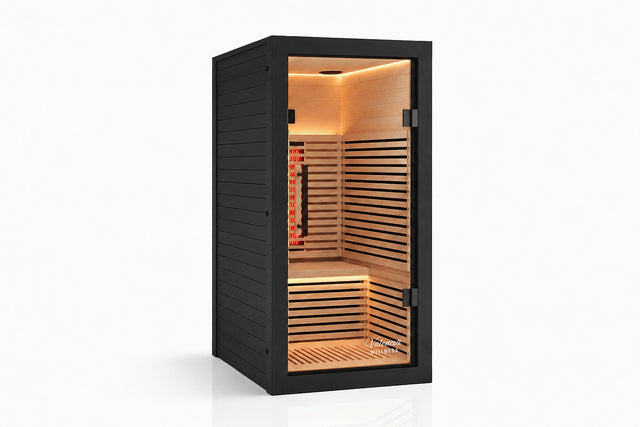
2. 1-Person Sauna: Best for Solo Routines
A 1-person sauna is a smart choice if your goal is consistent, private sessions—especially for post-work decompression, quiet recovery, or a simple wellness routine that doesn't require coordinating schedules.
Who should buy a 1-person sauna?
• You'll use it alone almost every time and want the smallest footprint that still feels premium.
• Your space is limited (condo, apartment, compact home gym, small basement corner).
• You prefer quick setup and easy access—less room planning, fewer compromises.
What to pay attention to (beyond "1-person")
• Seat/bench depth: A deeper bench often feels more relaxing even if the sauna is compact.
• Door swing and entry space: A sauna that technically fits can still feel tight if you're squeezing around the door.
• Interior height: If you're taller, check whether you can sit comfortably upright without feeling compressed.
Best use case: One person, 4–7 sessions per week, minimal fuss—your personal reset zone.
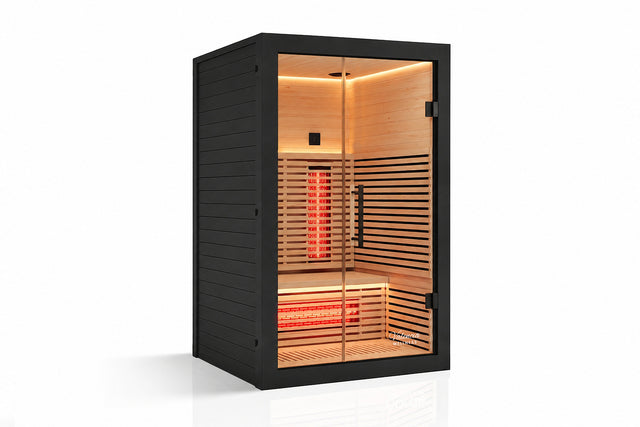
3. 2-Person Sauna: Best for Couples (and Flexible Solo Space)
For many homes, a 2-person sauna is the "sweet spot." It answers what size sauna should I buy for both solo wellness and occasional shared sessions—without committing to the larger footprint of a 3-person.
Who should buy a 2-person sauna?
• Couples who want to sauna together sometimes (even once or twice a week).
• Solo users who want extra room for changing positions, stretching, or longer sessions.
• Homes planning a wellness corner where comfort matters as much as space efficiency.
How "2-person" can feel very different by layout
Two-person models vary widely. Some are essentially "two seats," while others are "one long bench" where two can share. The second option often feels more flexible because you can sit centered alone, sit diagonally, or share space without feeling locked into one posture.
Tip: If you expect two adults to use the sauna together regularly, look for a layout that supports relaxed shoulders and comfortable elbow room—tight seating is the fastest way for a 2-person sauna to feel like a compromise.
4. 3-Person Sauna: Best for Shared Family Use
A 3-person sauna makes sense when sharing is the plan—not the exception. It's also the right direction if you want more room to stretch out, recline more naturally, or rotate multiple users through one session block.
Who should buy a 3-person sauna?
• Families who will share the sauna (or households where multiple people have their own routine).
• Entertainers: You want a sauna that can comfortably include guests.
• Anyone who wants true "space to breathe"—especially for longer sessions and deeper relaxation.
When a 3-person sauna is worth the extra footprint
• You want one person reclining while another sits upright.
• You want to avoid feeling cramped in shoulder/arm space.
• You plan to keep the sauna for years and don't want to outgrow it.
Space reality check: A 3-person sauna typically requires more than just the floor footprint. You also need comfortable approach space, a sensible door swing, and enough clearance for maintenance access depending on the model.
5. Bench Layout: The Detail That Changes "Capacity"
If you remember one thing while deciding what size sauna should I buy, make it this: capacity numbers are only a starting point. Bench design determines whether a sauna feels open and restorative—or tight and short-lived.
Bench style and what it means for usable space
• Single straight bench: Often the most flexible—easy to sit centered alone or share with another person.
• Two separate seats: Can feel structured (and sometimes narrower per person). Good if you like defined personal space.
• L-bench or wraparound bench: Common in larger interiors; can increase "real capacity" because users aren't shoulder-to-shoulder.
Comfort indicators to look for
• Bench depth: Deeper benches support relaxed posture and occasional legs-up lounging.
• Backrest angle and height: A supportive backrest can make a smaller sauna feel more comfortable for longer sessions.
• Heater/panel placement: Placement impacts where you can sit comfortably without crowding hot zones.
6. Measure Your Space: Real-World Fit & Clearance
Even a perfectly chosen capacity can fall apart if the sauna is difficult to access. A calm routine depends on a layout that feels effortless.
Clearances that matter (and are easy to overlook)
• Door swing and entry: Ensure you can open the door fully without bumping walls, gym equipment, or cabinetry.
• Walking space: Leave enough room to step in/out safely—especially if the floor may get damp.
• Ceiling height: Confirm the sauna height plus any leveling platform or flooring changes.
• Ventilation and electrical planning: Follow the manufacturer's installation requirements and local codes.
Practical tip: Tape the sauna footprint on the floor and "walk the routine"—approach, open the door, step in, and step out. If it feels tight with tape on the floor, it will feel tighter with real walls.
7. Comfort & Routine Upgrades That Affect Sizing
Some features don't sound like "size" decisions—but they change how much space you'll want in practice.
If you want longer sessions, consider more interior room
• Reading or guided breathing: You may want a more relaxed posture and more elbow room.
• Stretching or mobility work: A 2-person or 3-person model often supports this better than a compact 1-person.
• Shared sessions: Two people facing forward on a straight bench can feel close quickly—extra width improves comfort.
Pairing sauna with a full home wellness routine
If your sauna is part of a broader relaxation setup—massage chair sessions, contrast routines, or a calm end-of-day ritual—planning a little extra space around the sauna can make the entire area feel more luxurious and less cramped.
Explore Valencia's wellness lineup here: Wellness Series.
8. Choosing a Sauna Size: A Simple Checklist
Use this checklist to land on the right answer to what size sauna should I buy—without overthinking it.
• I will use it alone most of the time: start with a 1-person, or a roomy 2-person if you want extra comfort.
• I will use it with a partner weekly: choose a 2-person with a bench layout that gives shoulder and elbow room.
• My household will share it or I want stretch space: consider a 3-person and plan the room layout first.
• I want to recline or put legs up: prioritize bench depth and usable bench length (often easier in 2- or 3-person models).
• I don't want to outgrow it: size up if your space allows—comfort tends to win over time.
If you're still deciding between two sizes, the tie-breaker is usually consistency: choose the sauna you can place properly and use effortlessly. The best sauna is the one that fits your life and gets used.
Frequently Asked Questions
What size sauna should I buy for one person?
If you'll sauna alone almost every time, a 1-person sauna is usually enough—especially if your goal is a consistent daily or near-daily routine. If you want extra room to stretch, change positions, or simply avoid a snug feel, a 2-person sauna can be a more comfortable solo luxury option.
Is a 2-person sauna actually comfortable for two adults?
Yes, a 2-person sauna can be comfortable for two adults, but it depends heavily on bench layout and interior width. Two-person models vary: some feel like two defined seats, while others provide a longer shared bench. If you plan to sauna together often, prioritize elbow/shoulder room and a layout that doesn't force you into one posture.
Should I buy a 3-person sauna if I only use it alone?
Only if you want the extra space for stretching, reclining, or a more open feel—and your room layout supports it. A 3-person sauna can be a beautiful solo experience, but it's usually more footprint than most solo routines require. Many solo users get the comfort they want from a well-designed 2-person sauna.
How much space should I leave around a home sauna?
Leave enough space for the door to open comfortably and for safe entry/exit, plus any clearance the manufacturer requires for ventilation, electrical access, and maintenance. A sauna that "fits" but is hard to access tends to get used less—so plan for real-world movement, not just the listed dimensions.
Does bench design matter as much as sauna size?
Yes—bench design often determines real usable capacity more than the stated "1-, 2-, or 3-person" label. Bench depth, backrest support, and layout (straight bench vs L-bench vs separate seats) change how relaxed you can sit and whether two people feel comfortable sharing.
Is a 2-person or 3-person sauna better for a family?
For families who plan to use the sauna together regularly—two or more people at the same time—a 3-person sauna usually gives enough room to feel comfortable without feeling crowded. A 2-person works well for families where members tend to take turns rather than go in at the same time. Think about your most common use pattern and choose accordingly.
Does a bigger sauna cost more to run?
Generally yes—larger saunas require more heater output to warm the space, which means more electricity per session. A 3-person sauna will typically cost more to run than a 1-person, especially during heat-up. How significant the difference is depends on the heater type (infrared vs traditional), the model's insulation quality, and your local electricity rate.


