

In this article: A practical guide to wall hugger recliner mechanics, how to measure your room correctly, and what to look for in mechanism quality before you buy.
- How the Wall Hugger Mechanism Works
- How to Measure Your Space Correctly
- Where Wall Hugger Design Solves Real Problems
- What Changes When You Choose Wall Hugger
- Mechanism Quality: What Separates Good from Poor
- Wall Hugger in Valencia Theater Seating
- Frequently Asked Questions
The appeal of a wall hugger recliner is straightforward: it reclines fully without requiring the 18–24 inches of open space behind the chair that a standard recliner demands. In a small room, a basement media space, or any setup where seating sits close to a back wall, that difference is often the deciding factor between making a room work and not. But "wall hugger" is applied loosely in the furniture industry, the actual clearance required varies significantly between products, and the mechanism has real implications for room layout that aren't obvious from the marketing description. This guide covers what you actually need to know.

Understanding how the mechanism works, how to measure your specific room, and what separates a quality wall hugger from a cheap one will give you enough information to make a decision that doesn't require rearranging your room after the furniture arrives.
Quick Takeaways
• Wall hugger recliners need 4–6 inches from the wall, not 18–24.
The forward-sliding mechanism keeps the rear footprint close to the wall throughout the recline arc.
• The reclined footprint depth is the same as a standard recliner.
The seat slides forward, not outward — total room depth from wall to footrest tip is unchanged. What you save is the space behind the chair.
• Measure walk-in clearance, not just wall distance.
The minimum 18 inches of clearance in front of the seat applies to wall hugger and standard recliners equally. A tight room can still fail even with a wall hugger if there isn't enough space in front.
• Steel track mechanisms outperform plastic over time.
Plastic slider tracks can develop rattle and binding under load as tolerance wears. Steel tracks maintain their precision and feel through thousands of cycles.
• All power features are compatible with wall hugger mechanisms.
Power recline, power headrest, power lumbar, heat, and massage all work with the forward-slide design. Products that omit these features aren't limited by the mechanism — they're budget compromises.
1. How the Wall Hugger Mechanism Works

To understand why a wall hugger needs so little clearance behind it, you need to understand what a standard recliner requires and why.
How a Standard Recliner Reclines
In a standard recliner, the backrest tilts backward away from the occupant. As it tilts, the back of the chair sweeps outward and backward through open space. To complete a full recline, the chair needs 18–24 inches of clearance between the back of the chair and the nearest wall or obstacle. The seat typically tips slightly as well, but the dominant motion is the backrest sweeping rearward.
How a Wall Hugger Reclines
A wall hugger uses a forward-sliding track system. As you initiate the recline, the entire seat assembly moves forward on its tracks — typically 6–8 inches — while the backrest simultaneously arcs backward. The forward motion of the seat cancels out the rearward sweep of the backrest. The net result is that the back of the chair stays in approximately the same position relative to the wall throughout the recline arc.
The practical outcome: 4–6 inches of wall clearance instead of 18–24 inches. The 12–18 inches you save is real, usable room space — not a rounding difference.
How the Motion Feels
The forward slide changes the sensation of reclining slightly. Rather than feeling the seatback tip away behind you, you feel the seat move forward under you while you lean back into a position that remains stationary relative to the room. Most users don't notice this difference after the first session. It doesn't affect the reclined position, the support geometry, or the comfort experience in any meaningful way.
2. How to Measure Your Space Correctly

The most common planning error with wall hugger seating is focusing only on the wall clearance and ignoring the other dimensions that determine whether the room actually works. Here is the complete picture.
| What to Measure | Standard Recliner | Wall Hugger | Notes |
|---|---|---|---|
| Wall clearance required | 18–24 inches | 4–6 inches | Verify product spec sheet; "wall hugger" is sometimes loosely applied |
| Reclined depth (chair nose to footrest tip) | 65–72 inches | 65–72 inches | Same reclined footprint — seat slides forward, not outward |
| Walk-in clearance in front of seat | 18–24 inches minimum | 18–24 inches minimum | Same requirement for both types; often overlooked in planning |
| Upright depth | 32–38 inches | 32–38 inches | Chair depth when not reclined is similar between types |
The Four-Step Room Measurement Process
• Step 1: Measure the usable room depth — from the back wall to the nearest fixed obstacle in front of the seating position (TV stand, screen wall, structural column, or the nearest row of seats).
• Step 2: Subtract the reclined chair depth (65–72 inches, depending on the specific model). The remaining space is your walk-in clearance.
• Step 3: Confirm the walk-in clearance is at least 18 inches. This is the minimum to walk past a reclined seat without stepping over the footrest. In practice, 24 inches is more comfortable, particularly in a multi-seat row.
• Step 4: Confirm the specific product's wall clearance requirement from the spec sheet. Not all products labeled wall hugger maintain the same clearance spec — some require up to 10–12 inches despite the label.
Why This Matters in a 14-Foot Room
In a room 14 feet (168 inches) deep, a standard recliner requires 24 inches behind the chair. The reclined chair takes 68 inches. That leaves 76 inches — just over 6 feet — in front of the footrest for screen distance. With a wall hugger, you recover those 24 inches behind the chair and can position the seat 24 inches closer to the back wall if needed, gaining 24 inches of screen distance. In a space-constrained room, that's the difference between adequate and comfortable viewing geometry.
3. Where Wall Hugger Design Solves Real Problems

Wall hugger mechanisms address specific real-world placement constraints that standard recliners cannot accommodate without compromising either the recline function or the room layout.
Small Apartments and Condos
In a living room or media space under 12 feet deep, a standard recliner either cannot reach full recline or forces seating so far from the screen that viewing distance is uncomfortable. A wall hugger allows full recline in rooms where standard recliners simply don't work. The 12–18 inches saved behind the chair is often the entire difference between a room that functions and one that doesn't.
Home Theaters Where Screen Distance Matters
Dedicated home theater design optimizes screen distance for image size and resolution. When seating must sit near the back wall to maintain that distance, a standard recliner forces a choice: sacrifice full recline or push seating away from the back wall and closer to the screen than ideal. Wall hugger eliminates that trade-off. The seat can sit within 6 inches of the back wall and still recline fully, preserving the viewing geometry the room was designed around.
Canadian Basement Media Rooms
Basement home theater is the most common dedicated media room setup in Canadian homes, and basements routinely present placement constraints that above-grade rooms don't. Structural support columns appear mid-room. HVAC ductwork drops ceiling height and restricts where furniture can sit. Gas line access panels and electrical panels occupy wall sections. These constraints often push seating toward the back wall regardless of preference. Wall hugger seating adds the placement flexibility to work around fixed structural elements without sacrificing recline capability.
Rooms with Radiators, Trim, or Windows Behind Seating
In older homes, baseboard radiators, deep window sills, wainscoting, and trim profiles project 2–6 inches from the wall surface. These projections eat into the already-limited clearance behind a standard recliner. A wall hugger's 4–6 inch wall clearance requirement leaves room to clear most fixed wall projections without requiring furniture to be pulled further into the room.
4. What Changes When You Choose Wall Hugger

Choosing wall hugger introduces a few practical differences from standard recliner use. None of them are significant disadvantages in a properly measured room — but they're worth understanding before you commit.
The Forward Slide and Its Effect on Sightlines
When the seat slides forward 6–8 inches during recline, your seating position moves slightly closer to the screen. In a properly measured room with adequate screen distance, this is imperceptible in terms of viewing quality. In a very tight room — under 12 feet of total depth — verify that your knee-to-screen distance after the forward slide remains adequate for your screen size. At under 12 feet, the forward slide can bring the occupant closer to the screen than the recommended viewing distance for large-format displays.
Feel in Use
The feel of reclining in a wall hugger chair is slightly different from a standard recliner on the first use. The seat moving forward under you while the backrest tilts back is a different motion than a standard tip-back recline. Virtually all users adapt to this within one session, and most report that the fully reclined position feels identical between types.
Feature Availability
Wall hugger is compatible with all power features: power recline, power headrest, power lumbar, heat, and massage. The forward-slide mechanism does not conflict with any of these. Products that omit power features while using a wall hugger mechanism are making budget compromises, not engineering ones. Premium theater seating maintains the full feature set regardless of which recline mechanism is used.
Zero Gravity Positioning
Zero gravity recline — a position where the legs are elevated to roughly heart level, reducing spinal compression — is achievable with a wall hugger mechanism. The forward-slide motion during recline doesn't conflict with reaching a zero gravity angle. If zero gravity positioning is a priority, confirm with the specific product that the recline range supports it; the mechanism itself doesn't prevent it.
5. Mechanism Quality: What Separates Good from Poor

Wall hugger mechanisms vary significantly in quality, and the difference becomes apparent over time in ways that aren't visible on day one.
Steel Track vs Plastic Slider Construction
The forward-slide mechanism requires a track system that the seat assembly rides along during recline. Quality mechanisms use steel slider tracks. Steel is quiet, precise, and rated for full weight capacity over thousands of cycles. It maintains its dimensional tolerances over years of use, meaning the slide continues to feel smooth and controlled throughout the product's life.
Lower-cost mechanisms use plastic or nylon slider tracks. Plastic is cheaper to manufacture and initially feels adequate. Over time, as the tolerance in the plastic components wears, the track develops small amounts of play — which produces rattle during the slide and, in some cases, binding under load near the rated weight capacity. The degradation is gradual enough that users often accept it as normal.
Cycle Ratings
A quality wall hugger mechanism should have a stated cycle rating at rated load. Cycle rating means the number of full recline-and-return cycles the mechanism has been tested to complete without degradation under the specified load. A minimum benchmark is 25,000 cycles. At one cycle per evening of use, 25,000 cycles is approximately 68 years of daily use — a figure that means the mechanism will outlast other wear factors by a large margin.
Mechanisms without a stated cycle rating are either untested or the manufacturer doesn't want to publish the number. Either is a reasonable indicator of quality level.
How to Identify Quality Before Buying
• Look for a specified cycle rating — 25,000 or above at rated load.
• Confirm steel track construction is specified, not just "durable" or "high-quality" without material detail.
• Check that the weight capacity has meaningful margin above typical user weights.
• Avoid products marketed as wall hugger with no mechanism specifications beyond the label.
A seller who can provide specific mechanism specs — track material, cycle rating, motor specification — is a seller who knows what they're selling. Vague answers should be treated as a negative signal.
6. Wall Hugger in Valencia Theater Seating

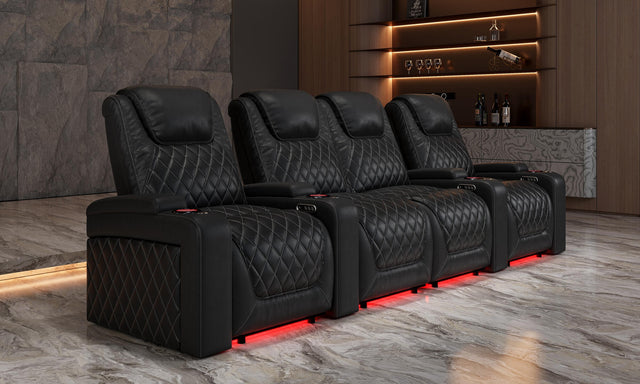
Valencia integrates wall hugger mechanisms across its theater seating line without reducing the available feature set — a distinction worth noting because some space-saving designs make compromises that premium theater seating doesn't need to make.
No Feature Trade-offs
Some wall hugger products strip the power headrest or power lumbar from the design to simplify the mechanism assembly. Valencia wall hugger seating maintains full power feature availability — power recline, power headrest, power lumbar, heat, and massage are all available in the same configuration as standard-mechanism models. The forward-slide mechanism doesn't require any feature reduction.
Construction Specifications
Valencia wall hugger seats use steel track systems combined with German-engineered linear actuator motors. The motor specification provides the durability needed for daily home theater use — cycle ratings appropriate for decades of regular use at rated capacity, not just light occasional use.
Canadian Basement Media Rooms
The most common dedicated home theater setup in Canadian homes is a finished basement media room — and basement rooms present more placement constraints than above-grade spaces. Structural elements, HVAC systems, support columns, and access panels restrict where seating can go in ways that open living rooms don't. Wall hugger seating addresses this directly. Seating that sits within 6 inches of a back wall reclines fully without requiring you to pull the row forward into the room, preserving the screen distance and room geometry the space was built around.
Frequently Asked Questions
How much space does a wall hugger recliner actually need from the wall?
A quality wall hugger recliner typically requires 4–6 inches of clearance between the back of the chair and the wall. This compares to 18–24 inches for a standard recliner. That said, "wall hugger" is applied loosely across the industry — some products labeled wall hugger require 10–12 inches. Always confirm the exact wall clearance spec from the product sheet before planning your room layout around it.
Does a wall hugger recliner recline to the same angle as a standard recliner?
Yes. A wall hugger recliner reaches the same recline angles as a standard recliner, including near-flat and zero gravity positions. The forward-slide mechanism changes how the chair achieves full recline, not the extent of the recline. The fully reclined position is functionally identical between a wall hugger and a standard recliner in terms of angle and body support.
Is the forward slide of the seat noticeable during normal use?
The forward slide — typically 6–8 inches — is perceptible on the first use and generally stops being consciously noticeable after that. Most users describe the sensation as the seat moving forward to meet a reclining position rather than the more familiar tip-back feeling of a standard recliner. The practical effect on viewing or comfort in the reclined position is negligible in a properly measured room.
Can I use a wall hugger recliner in zero gravity position?
Yes. Zero gravity positioning is compatible with wall hugger mechanisms. The forward-slide motion that keeps the chair close to the wall doesn't conflict with achieving a zero gravity recline angle. Confirm that the specific model you're considering has a recline range that reaches zero gravity — this is a feature of the motor and recline system, not the wall hugger mechanism itself.
Are wall hugger recliners durable enough for daily home theater use?
Quality wall hugger mechanisms with steel track construction and motors rated to 25,000+ cycles at rated load are fully suitable for daily home theater use. The forward-slide mechanism adds mechanical complexity compared to a simple tip-back recliner, which is why mechanism quality matters more than it does in a simpler design. A well-specified wall hugger with steel tracks and a proper cycle rating will hold up as well as any premium theater recliner.
What is the difference between a wall hugger and a space-saving recliner?
Wall hugger is a specific mechanism type: the seat slides forward as the backrest reclines, keeping the rear of the chair close to the wall. Space-saving is a broader marketing term that can refer to wall hugger mechanisms, reduced-depth chair frames, or chairs with limited recline range. A chair marketed as space-saving may not have a wall hugger mechanism at all — it might simply be a smaller chair. When wall clearance is your concern, look specifically for "wall hugger" with a stated clearance spec of under 6 inches, not just "space-saving."
Should I choose wall hugger if my room is exactly 12 feet deep?
A 12-foot room is tight for any recliner configuration. With a wall hugger (5 inches of wall clearance) and a 68-inch reclined chair depth, you have 144 minus 68 minus 5 equals 71 inches — about 6 feet — of space between the wall and the footrest tip. That 71 inches must contain the screen or the next obstacle. If the screen is wall-mounted, that's your viewing distance: approximately 6 feet from footrest tip to screen. At that distance, a 100-inch screen produces a viewing angle near the upper comfortable limit. Also remember the seat slides 6–8 inches forward during recline, reducing your viewing distance slightly further. A 12-foot room can work with a wall hugger, but measure your specific configuration carefully before ordering.
Do all power features work with wall hugger mechanisms?
Yes — power recline, power headrest, power lumbar, heat, and massage are all mechanically compatible with wall hugger mechanisms. There is no engineering reason a wall hugger chair cannot include all of these features. Products that omit power features while using a wall hugger mechanism are making cost-reduction decisions, not accommodation for mechanism constraints. Premium theater seating maintains the full feature set across wall hugger and standard mechanism configurations.


