

In this article: What to expect from different quality tiers of home theatre seating, the five factors that shorten lifespan, the maintenance habits that extend it, and how to read a warranty so you know what’s actually guaranteed.
- Lifespan by Quality Tier: What to Expect
- Five Factors That Shorten Your Seating’s Life
- Four Habits That Extend It
- What Your Warranty Actually Covers
- Repair vs. Replace: How to Tell the Difference
- Frequently Asked Questions
Premium home theatre seating built on a hardwood frame with Italian Nappa leather can last 15–20 years or more with basic care. Entry-level seating with bonded leather and lightweight frames typically shows significant wear within 3–5 years. The gap is not about brand loyalty—it’s about material quality, mechanism grade, and how consistently the owner maintains the leather.
This guide breaks down what “lifespan” actually means for each component, what shortens it, what extends it, and how to evaluate a warranty so you know what you’re actually covered for.
Quick Takeaways
• Frame quality determines the ceiling for everything else.
A kiln-dried hardwood or steel frame can outlast every other component by decades. Budget seating with particleboard or MDF frames is the leading cause of early structural failure.
• Italian Nappa leather and bonded leather are not comparable materials.
Top-grain and full-grain leather can be conditioned and maintained for decades. Bonded leather—a paper-and-fibre composite—typically begins to peel and flake within 3–5 years, and the damage cannot be reversed.
• Mechanisms are the component most affected by user habits.
Reclining mechanisms see the most mechanical stress. Exceeding weight ratings, forcing a stuck mechanism, and never lubricating the moving parts are the primary causes of early mechanical failure.
• A warranty length signals what the manufacturer believes about their product.
A 5-year frame warranty signals confidence in the construction. A 90-day “limited” warranty on all components signals the opposite. Read what’s actually covered, not just the headline number.
• Neglect—not use—is the biggest lifespan killer.
Dried, cracked leather cannot be reversed. Conditioning every 3–6 months is the highest-ROI maintenance step you can take, costing minutes and a few dollars to preserve thousands of dollars of furniture.
1. Lifespan by Quality Tier: What to Expect
Home theatre seating lifespan varies dramatically by material and construction grade. Here is a realistic breakdown of what to expect at each tier:
| Quality tier | Typical lifespan | Frame material | Upholstery |
|---|---|---|---|
| Entry-level | 3–5 years | Particleboard, MDF, or light gauge steel | Bonded leather or polyester fabric |
| Mid-range | 7–12 years | Hardwood or reinforced steel | Top-grain leather or high-grade microfibre |
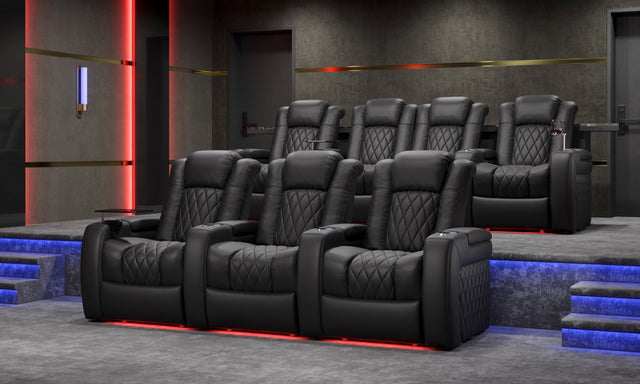
| Premium | 15–20+ years | Kiln-dried hardwood and/or steel | Full-grain or Italian Nappa leather (9000–20000 grade) |
The single largest driver of early failure across all tiers is the upholstery surface, not the frame. Bonded leather is not real leather: it is a paper-and-leather-fibre composite with a thin polyurethane coating that cannot be conditioned and will inevitably peel, crack, and delaminate. Once this process begins, it cannot be reversed. Italian Nappa leather, by contrast, is tanned cowhide that can be conditioned and repaired over its lifetime—and often becomes softer with age when properly maintained.
2. Five Factors That Shorten Your Seating’s Life
• Direct sunlight and UV exposure.
UV radiation breaks down the chemical bonds in leather dyes and fibres, causing fading and surface degradation. Even indirect sunlight through standard glass accelerates colour loss and surface cracking. Position seating away from windows, or use UV-filtering window treatments.
• Dry indoor air, especially in winter.
Heated indoor air strips moisture from leather. Without regular conditioning, leather fibres dry out, shrink, and crack. The damage is cumulative and irreversible once cracking occurs. Canadian homes are particularly at risk during the heating season.
• Exceeding weight ratings.
Every theatre seat has a rated weight capacity. Consistently exceeding it stresses the frame joints, compresses the foam faster, and strains the reclining mechanism. This is a common cause of frame joint failure at the 3–4 year mark on mid-range seating.
• Food and drink without prompt cleanup.
Food oils, sugars, and acids in beverages are absorbed into leather and foam if not cleaned immediately. They create stains that attract bacteria, degrade the leather finish, and cause persistent odour. Even small amounts of cooking oil absorbed into a leather armrest over years will discolour and soften the surface.
• No leather conditioning.
Leather without conditioning dries, stiffens, and cracks. A leather conditioner replenishes the natural oils that keep the fibres supple. Skipping this step—the cheapest and easiest maintenance task available—is the most common cause of premature leather failure on quality seating.
3. Four Habits That Extend It
 • Condition leather every 3–6 months (every 8–10 weeks in winter).
Use a quality leather conditioner specifically formulated for genuine leather. Apply with a clean microfiber cloth, allow 15–20 minutes to absorb, and buff off excess. This single routine is more impactful on longevity than any other maintenance action.
• Clean spills immediately—always blot, never rub.
Blotting lifts liquid out of the leather. Rubbing pushes it deeper into the grain and spreads it. Immediate attention to spills prevents staining and surface degradation before they begin. For a complete guide to stain removal, see The Best Way to Remove Stains from a Leather Couch.
• Maintain room humidity at 40–50% in winter.
A humidifier in a home theatre room is one of the best investments for leather longevity. Consistent humidity prevents the moisture-loss cycle that causes the most leather damage in Canadian homes.
• Check and lubricate reclining mechanisms annually.
Reclining mechanisms benefit from an annual inspection. Listen for squeaking, grinding, or resistance—these are early warning signs of friction wear that can be addressed cheaply with lubrication before they become structural failures.
4. What Your Warranty Actually Covers
A home theatre seating warranty typically covers three separate components with different durations. Understanding what each covers—and what voids each—prevents surprises:
| Component | Typical coverage (premium) | What is usually excluded |
|---|---|---|
| Frame | 5–10 years (or lifetime) | Damage from exceeding weight capacity, improper installation, or commercial use |
| Reclining mechanism | 3–5 years | Damage from forcing a stuck mechanism, exceeding weight limits, or unauthorized repair |
| Leather / fabric | 1–3 years (manufacturing defects) | Normal wear, sun fading, damage from improper cleaning products, scratches |
• What “defect” means.
Most warranties cover manufacturing defects—stitching that fails, mechanisms that break under normal use—but not wear-and-tear, cosmetic changes, or damage caused by improper care.
• Whether cleaning chemicals void the warranty.
Using harsh cleaners (alcohol, acetone, bleach) on leather often voids the leather warranty in addition to causing irreversible damage. Read the care guidelines before applying any cleaning product.
• Residential vs. commercial use.
Nearly all residential furniture warranties explicitly exclude commercial use. Using residential theatre seating in a commercial screening room typically voids the warranty entirely.
5. Repair vs. Replace: How to Tell the Difference
| Symptom | Verdict | Notes |
|---|---|---|
| Mechanism squeaks or moves stiffly | Repair | Usually lubrication or a replaceable part; most manufacturers sell mechanism parts |
| Leather feels stiff but has no cracks | Repair | Deep conditioning over 2–3 applications typically restores suppleness |
| Small scratch or scuff on leather surface | Repair | Leather repair kits work well on minor surface damage; larger repairs by a leather technician |
| Bonded leather peeling or flaking | Replace | Delamination of bonded leather cannot be reversed; only gets worse over time |
| Frame creak or visible joint movement | Assess | Loose screws: repair; cracked frame member: replace |
| Foam compression (seat permanently soft or uneven) | Reupholster or replace | Foam can be replaced by an upholsterer if the frame and leather are still serviceable |
| Motor failure on power recliner | Repair | Motors are typically replaceable; check parts availability with the manufacturer first |
Frequently Asked Questions
How long should home theatre seating last?
Premium home theatre seating with a hardwood or steel frame and Italian Nappa leather typically lasts 15–20 years with regular conditioning and care. Mid-range seating with top-grain leather and a solid hardwood frame generally lasts 7–12 years. Entry-level seating with bonded leather and lightweight frames often shows significant wear within 3–5 years. The leather or fabric is almost always what fails first—the frame and mechanism often have years of useful life remaining.
What’s the difference between Italian Nappa leather and bonded leather in terms of durability?
Italian Nappa is genuine tanned cowhide that can be conditioned, cleaned, and repaired over its lifetime—it often becomes softer and more characterful with age when properly maintained. Bonded leather is a paper-and-leather-fibre composite with a thin polyurethane coating. It cannot be conditioned, and once its coating begins to peel or flake (typically within 3–5 years of regular use), the process is irreversible. The two materials are not comparable in longevity.
What typically fails first on a reclining theater seat?
The leather or fabric surface almost always shows wear before the frame or mechanism fails on quality seating. On budget seating, the reclining mechanism and frame joints are more common early failure points. Mechanisms typically show wear through squeaking, stiff operation, or failing to lock in the reclined position. These are often repairable if caught early.
What does a home theatre seating warranty typically cover?
Most warranties cover three components separately: the frame (typically the longest coverage, sometimes lifetime), the reclining mechanism (typically 3–5 years on premium seating), and the leather or fabric (typically 1–3 years, covering manufacturing defects only—not normal wear). Always read what specifically is excluded—most warranties do not cover damage from improper cleaning chemicals, sun exposure, or exceeding weight capacity.
My theater seat is squeaking — does that mean it’s time to replace it?
Almost never. Squeaking is typically the first sign of friction in the reclining mechanism—a lubrication issue, not a structural failure. Apply a dry lubricant (silicone spray or white lithium grease) to the mechanism joints and pivot points. If the squeak persists after lubrication, contact the manufacturer to identify whether a specific part needs replacement. Replacement is warranted when the mechanism fails to hold position or cannot be opened/closed safely.
Does how often I use my theater seating affect how long it lasts?
Use frequency matters less than maintenance frequency. Seating that is used daily and conditioned every 3 months will typically outlast seating that is used occasionally but never conditioned. The leather’s enemy is dryness, not use. That said, heavy daily use does accelerate foam compression and mechanism wear—both of which can be addressed without full replacement if the frame and leather are maintained.
What is the single most important maintenance step for leather theater seating?
Conditioning. A quality leather conditioner applied every 3–6 months (more frequently in winter) replaces the natural oils that keep leather fibres supple and prevents the cracking and fading that are the leading causes of premature leather failure. It takes about 10 minutes per application and costs a fraction of the seating’s value. For a full care routine, see our Italian leather sofa care guide.


