

In this article: A precise measurement guide to home theater row spacing — covering recliner floor footprints, front-row placement, two-row center-to-center distances, aisle clearances, and three worked layout examples.
- Why Row Spacing Is the Most Commonly Underestimated Decision
- Front-Row Placement: Screen Distance and Side Clearances
- Two-Row Spacing: Center-to-Center Distance
- Aisle Width and Exit Clearance
- Three Worked Layout Examples
- Frequently Asked Questions
Row spacing in a home theater is not intuitive. The numbers that look right on paper — a three-seat row in a twelve-foot room, two rows in a twenty-foot space — often fail in practice because recliner geometry is fundamentally different from standard furniture. A theater recliner at full extension occupies nearly twice the floor area it appears to need when upright. This guide works through the real measurements, row by row.

Every number in this guide assumes power recliners — the standard for dedicated home theaters. Manual recliners have similar but slightly smaller footrints. Loveseats follow the same depth logic as individual seats. The math is the same regardless of seat count in the row.
Quick Takeaways
• Recliner floor depth is 44–52 inches per row minimum.
Seat depth upright (22–26 in) plus full footrest extension (20–24 in) plus a 2-in safety margin. Never assume a recliner fits based on upright depth alone.
• Front-row distance is 1.0–1.5× the screen width.
For a 120" screen (105 in wide): front row sits 105–157 inches from the screen face. Position the front of the seat, not the headrest, as your measurement point.
• Two rows need 48–60 inches center-to-center depending on recliner use.
48 in: walkable but neither row can fully recline simultaneously. 54 in: front row reclines while rear row is upright. 60 in: both rows can recline simultaneously.
• Side clearances: 12 inches minimum, 18–24 inches comfortable.
Twelve inches is tight but walkable. Below 12 inches you cannot pass at all. Plan 18 inches per side as a working target.
• Staggering back-row seats improves sightlines without changing dimensions.
Shift the back row 14–18 inches sideways so occupants look between front-row headrests. Requires side clearance on one side to absorb the offset.
Interactive Layout Calculator
Enter your room and screen below — this checks whether your row count and seating actually fit, using the same THX / SMPTE viewing-angle math and recliner floor-depth figures worked through above.
Your Room
Your Layout, Measured
Step 2 — Shop Seating for This Layout
Tell us a bit more — we'll point you to the best-suited model
Always confirm the exact upright and reclined depth for your specific seat model before ordering — this tool plans the room, it doesn't replace the spec sheet.
1. Why Row Spacing Is the Most Commonly Underestimated Decision

Most homeowners measure seating against room depth using the upright seat dimension. This is the mistake. A theater recliner's usable floor footprint — the area it occupies when someone is seated and reclined — is determined by two measurements that are rarely shown together on product pages.
The Two Dimensions That Actually Matter
• Upright seat depth: the depth of the seat from front edge to the back of the backrest, measured at the floor. Typically 22–26 inches for theater recliners.
• Footrest extension: how far the extended footrest reaches in front of the seat when at full recline. Typically 18–24 inches beyond the front edge of the seat.
The floor depth a row requires is the sum of these two plus a minimum 2-inch clearance at the footrest tip: 22 + 20 + 2 = 44 inches at the low end, 26 + 24 + 2 = 52 inches at the high end.
| Seat Type | Upright Depth | Extension at Recline | Minimum Floor Depth | Recommended Floor Depth |
|---|---|---|---|---|
| Compact theater recliner | 22 in | 18 in | 42 in | 46 in |
| Standard theater recliner | 24 in | 20 in | 46 in | 50 in |
| Large theater recliner | 26 in | 22 in | 50 in | 54 in |
| Big-and-tall recliner | 28 in | 24 in | 54 in | 58 in |
Why the Recommended Depth Is Higher Than the Minimum
The minimum allows the footrest to extend without touching a wall or obstruction. The recommended adds 4–6 inches of practical buffer — the difference between a footrest that just clears an obstacle and one that you can extend without anxiety. In a room where the front row is near the screen wall, even 2 extra inches of clearance matters significantly when you have guests.
Verify the extension dimension for your specific seat model with the manufacturer before finalizing room layout. Product pages sometimes list only upright depth.
2. Front-Row Placement: Screen Distance and Side Clearances

The front row of a home theater is positioned relative to the screen, not the room's back wall. This reverses the intuitive planning sequence: start at the screen, work backwards.
Viewing Distance Formula
The industry standard for home theater front-row placement is 1.0–1.5× the screen width, measured from the screen face to the front of the seat. At 1.0× you are in the highly immersive zone — the screen fills most of your horizontal field of vision. At 1.5× the experience is relaxed and comfortable for extended viewing.
| Screen Size | Screen Width (approx.) | Immersive (1.0×) | Comfortable (1.25×) | Relaxed (1.5×) |
|---|---|---|---|---|
| 100" diagonal | 87 in (7.3 ft) | 87 in (7.3 ft) | 109 in (9.1 ft) | 131 in (10.9 ft) |
| 110" diagonal | 96 in (8.0 ft) | 96 in (8.0 ft) | 120 in (10.0 ft) | 144 in (12.0 ft) |
| 120" diagonal | 105 in (8.75 ft) | 105 in (8.75 ft) | 131 in (10.9 ft) | 157 in (13.1 ft) |
| 135" diagonal | 118 in (9.8 ft) | 118 in (9.8 ft) | 147 in (12.3 ft) | 177 in (14.75 ft) |
Screen center height: position the vertical center of the image at 42–48 inches from the finished floor. This aligns with the natural eye level of a reclined adult. If the screen center is significantly lower (under 38 in) or higher (over 54 in), front-row occupants will experience neck angle discomfort on long viewing sessions.
Side Clearances
• 12 inches per side: functional minimum. A person can turn sideways to pass but cannot walk through comfortably.
• 18 inches per side: the comfortable working target for most rooms. A person can pass in front of a seated occupant without requiring them to tuck their feet in.
• 24 inches per side: preferred where budget allows — allows full walking posture in the side aisle.
• 36 inches: required for a proper ADA-compliant accessible aisle (not required in private residences but worth planning for if accessibility is a consideration).
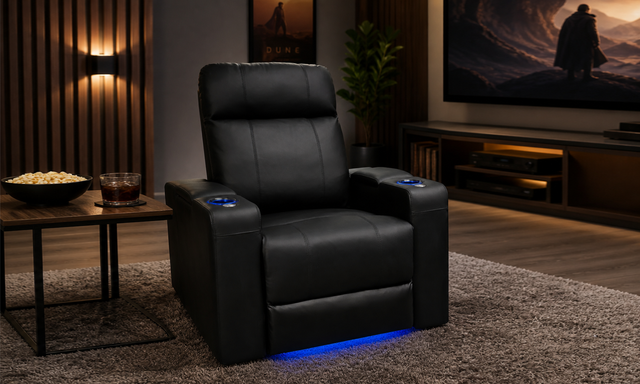
Usable seat width calculation: room width minus both side clearances equals the usable span for seating. A 144-inch (12 ft) room with 18-inch clearances on each side yields 108 usable inches. A three-seat row of 28-inch-wide seats (including armrests) requires approximately 86 inches — comfortably within that envelope with 22 inches to spare for seat frame tolerance and minor alignment variation.
3. Two-Row Spacing: Center-to-Center Distance

Center-to-center distance is measured from the back of the front-row seat base to the back of the rear-row seat base, at floor level. This number determines whether people can walk between rows and whether both rows can recline simultaneously.
Center-to-Center Reference Guide
| Center-to-Center | Walkability | Front Row Reclines | Both Rows Recline Simultaneously | Best For |
|---|---|---|---|---|
| 42 in | Not walkable | With care | No | Not recommended for theater use |
| 48 in | Tight but passable | Yes | No | Space-constrained two-row builds |
| 54 in | Comfortable | Yes | Front row only, with caution | Standard two-row home theater |
| 60 in | Generous | Yes | Yes | Premium two-row builds, both rows full-recline |
| 66+ in | Very open | Yes | Yes, with margin | Large rooms, riser builds with extended seat depth |
The Simultaneous Recline Constraint
When the front row reclines, the footrest moves forward — away from the back row. This is not the constraint. The constraint is the rear row: when the rear row reclines, the footrest moves forward, toward the aisle between rows. If center-to-center is 48 inches and the front-row seat is 24 inches deep, the aisle is 24 inches. A rear-row recliner at full extension adds 20+ inches toward the aisle — leaving 4 inches or less of clearance between the extended footrest and the front-row seat back. At 60 inches center-to-center with a 24-inch seat: 36 inches of aisle, accommodating a 20-inch footrest extension with 16 inches to spare.
Sightline Staggering
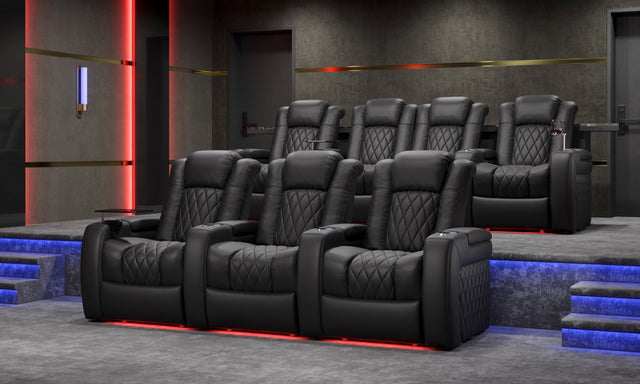
Staggering shifts the back row laterally 14–18 inches relative to the front row, so back-row viewers see between front-row headrests rather than directly behind them. This is standard practice in professional cinema design. In a home theater, staggering requires one side clearance to absorb the offset — if the back row shifts 16 inches to the right, the right-side clearance on the back-row side must be 16 inches wider than the front-row right clearance. Plan this into the room before ordering.
4. Aisle Width and Exit Clearance

Aisles in a home theater serve two purposes: people movement during viewing (someone leaves for the bathroom, returns mid-film) and emergency egress. The first drives comfort requirements; the second drives minimum requirements.
Between-Row Aisle
• 24 inches: the minimum practical walking width between rows when both rows are upright. A person can pass sideways.
• 30 inches: comfortable single-direction movement between rows.
• 36 inches: preferred standard for comfortable two-direction passing and accessible movement.
Between-row aisle width is determined by center-to-center distance minus both seat depths. At 54 in center-to-center with 24-in seats: 54 − 24 − 24 = 6 in net clearance when both rows are upright. Wait — that is not the aisle. Center-to-center from the back of the front-row seat base to the back of the rear-row seat base includes the depth of the rear seat as well. Correct measurement: aisle = center-to-center − front-row depth − rear-row depth. Rearranged: center-to-center = desired aisle width + front-row depth + rear-row depth. For a 30-in aisle with 24-in seats: 30 + 24 + 24 = 78 in. Wait — this overstates it. The simpler way: front-row back-of-seat-base to rear-row front-of-seat-base = the aisle. This equals center-to-center − rear-seat depth. At 54 in center-to-center, rear seat 24 in deep: 54 − 24 = 30 in usable aisle when walking between the back of the front-row seat and the front of the rear-row seat. At 60 in: 36 in aisle.
Entry and Exit Clearance
• Entry doors: ensure the door swing does not arc into any seated position. Sliding or pocket doors are ideal for theater rooms; hinged doors should open away from the seating area.
• Step lighting: mark all aisle transitions, riser edges, and side aisles with low-voltage LED strips. Navigation in a dark room without step lighting is a safety issue, particularly on riser edges.
• Side aisles at walls: the clearances between the outermost seats and the wall are also aisles. The 12-inch minimum assumes people will not walk through this space mid-film. If your side aisles are your only entry/exit path for a row, plan 24 inches minimum.
5. Three Worked Layout Examples

The following examples work through real room dimensions, screen sizes, seat models, and recliner extensions. Use these as templates for your own room.
Example A: 10 × 16 ft Room, Single Row, 110" Screen
• Usable room width: 120 in. Side clearances at 18 in each: 84 in usable for seating. Three-seat row at 28 in per seat: 84 in — fits exactly with 0 in margin. Reduce to 16 in clearances per side to gain 8 in of margin, or choose a slightly narrower seat.
• Screen at 110" (96 in wide). Comfortable viewing distance: 120 in (1.25×). Screen face to front-of-seat: 120 in = 10 ft from screen wall.
• Remaining room depth from front of seat to back wall: 192 in (16 ft) − 120 in (viewing distance) − 50 in (seat floor depth) = 22 in behind the seats. Adequate for a rear access path.
• Result: viable single-row layout. Three seats, 110" screen, 10-ft viewing distance.
Example B: 12 × 22 ft Room, Two Rows, No Riser, 120" Screen
• Usable room width: 144 in. Side clearances at 18 in each: 108 in usable. Three-seat front row at 28 in per seat: 84 in (24 in to spare). Three-seat back row, staggered 14 in: 98 in (10 in spare on the offset side).
• Screen at 120" (105 in wide). Comfortable viewing distance: 131 in (1.25×). Screen face to front-of-seat: 131 in.
• Front-row floor depth: 50 in (standard theater recliner).
• Center-to-center target: 60 in (both rows can fully recline).
• Total depth consumed: 131 in (viewing distance) + 50 in (front-row depth) + 60 in (center-to-center) + 50 in (rear-row depth) = 291 in = 24.25 ft. Room is 22 ft (264 in). This does not fit with 60 in center-to-center. Reduce to 48 in center-to-center: 131 + 50 + 48 + 50 = 279 in = 23.25 ft. Still tight for a 22-ft room. Reduce screen viewing distance to 1.0× (105 in): 105 + 50 + 48 + 50 = 253 in = 21.1 ft — fits in 22 ft with 11 in to spare behind the back row. Result: feasible, but front row must be at 1.0× distance and only front row can recline during simultaneous viewing.
Example C: 13 × 26 ft Room, Two Rows with Riser, 135" Screen
• Usable room width: 156 in. Side clearances at 24 in each: 108 in usable. Front row: 3 seats × 30 in = 90 in (18 in spare). Back row: 3 seats × 30 in staggered 16 in: 106 in (2 in spare — tight but workable).
• Screen at 135" (118 in wide). Comfortable viewing distance: 148 in (1.25×). Screen face to front-of-seat: 148 in.
• Front-row floor depth: 52 in. Riser starts behind front-row footrest clearance.
• Center-to-center: 60 in (both rows full recline).
• Total depth: 148 + 52 + 60 + 52 = 312 in = 26 ft — fits exactly in the 26-ft room with no rear margin. Add 8 inches by reducing center-to-center to 58 in (still allows simultaneous recline with margin).
• Result: viable premium two-row build. Riser at 10 in height (9-ft ceiling: 9 ft − 10 in riser − 20 in seat height − headroom = 7 ft 6 in on platform, comfortable).
Frequently Asked Questions
What is the minimum row spacing for theater recliners?
The absolute minimum for a single row is 44–46 inches of floor depth (seat depth plus footrest extension plus a small clearance margin). For two rows, the minimum center-to-center distance is 48 inches, which allows walking between rows but does not allow simultaneous full recline on both rows. For simultaneous full recline on both rows, 60 inches center-to-center is the recommended target.
Can both rows recline at the same time without hitting each other?
Yes, if the center-to-center spacing is sufficient. At 60 inches center-to-center, both rows can typically recline simultaneously without contact. The front-row footrest extends forward toward the screen; the rear-row footrest extends into the aisle between rows. The rear row's footrest extension is the binding constraint. Verify with your specific seat model: measure the footrest extension and subtract from the available aisle depth to confirm clearance.
What is sightline staggering and how do you set it up?
Sightline staggering shifts the back row laterally 14–18 inches relative to the front row so that back-row viewers look between front-row headrests rather than directly behind them. In practice, you mark the back-row center 14–18 inches offset from the front-row center and position seats accordingly. The side clearance on the wider side of the room must absorb this offset — ensure you have the extra space before committing to the layout.
How much side clearance do I need beside the outermost seats?
The minimum functional clearance is 12 inches — enough to pass sideways in an emergency but not comfortable for regular movement. Plan 18 inches as a working target for side aisles people do not use often, and 24 inches if the side aisle is the primary entry and exit path for that row. If the side aisles are your only way in or out of a row during a film, the wider the better.
What happens if I don't have enough recliner clearance in front of the front row?
If the front-row footrest cannot extend fully, the recliner stops mid-recline when the footrest contacts the wall or obstruction. Most power recliners will stop when they encounter resistance, so no physical damage occurs — but the seat cannot reach the fully reclined position. The practical solution is to move the front row back, reduce screen size to maintain viewing distance, or switch to a seat with a shorter footrest extension.
How do loveseats affect row spacing calculations?
Loveseats follow the same depth math as individual seats — the footrest extension and floor depth requirements are per unit, not per seat. A two-person loveseat typically occupies 50–60 inches of width but the same depth as a single recliner. Row spacing calculations use the depth dimension, which does not change. The width calculation simply substitutes the loveseat width for the individual-seat-width-times-count formula.
Does a curved arrangement change the spacing requirements?
A gently curved single row does not significantly change depth requirements — the seats are all approximately the same distance from the screen, which is the point of the curve. In a two-row curved setup, the center-to-center measurement must be taken at the tightest point (usually where the curvature brings rows closest together), and that measurement must meet the minimum spacing requirement. Curved rows are almost always in single-row configurations for this reason.
How do I know if my room is big enough for two rows before I order?
Add up these five numbers: (1) screen-to-front-seat distance (1.0–1.5× screen width), (2) front-row floor depth (seat depth + extension + margin), (3) center-to-center distance (48–60 in depending on recline requirements), (4) rear-row floor depth (same as front), (5) clearance behind the rear row (18 in minimum). If that total is less than your room depth, two rows are feasible. If it exceeds your room depth, you need to reduce screen size, viewing distance, or center-to-center spacing — or accept that the room supports one row only.


