

In this article: A practical guide to home theater risers — covering when you need one, how to calculate the correct height and dimensions, step-by-step DIY construction, built-in carpentry alternatives, riser wiring, and choosing the right seating for the platform.
- When You Actually Need a Riser
- Calculating Riser Height and Dimensions
- DIY Riser: Materials and Construction
- Built-In Carpentry: When to Hire a Contractor
- Wiring the Riser: Power, USB, and Step Lighting
- Choosing Seating for Your Riser Platform
- Frequently Asked Questions
A home theater riser is an elevated platform that raises the rear row of seating so occupants can see over the front-row headrests. Without a riser, a two-row home theater delivers a poor experience for anyone in the back — the bottom quarter of the screen is blocked by the people sitting in front. With a properly sized riser, every seat in the room has an unobstructed sightline. This guide covers the entire process from whether you need a riser through to finishing and wiring.

The riser is the most structural and permanent decision in a home theater build. Unlike seating or AV equipment, a built riser cannot be swapped out — the height, depth, and width are fixed once construction is complete. Measure and calculate before building.
Quick Takeaways
• A riser is mandatory for almost all two-row builds.
Without a riser, back-row sightlines are blocked by front-row headrests unless the screen is positioned impractically high. The riser is the standard engineering solution.
• Riser height is determined by your specific seat model.
Measure the front-row seat's headrest height before setting the riser height. The back-row eye level must clear that headrest by at least 6 inches. Most builds land at 8–12 inches.
• Platform depth must include full recliner extension.
Seat depth upright plus full footrest extension plus a safety margin. Typically 52–64 inches of platform depth for standard theater recliners. A platform that is too shallow prevents full recline.
• Run all wiring through the riser interior before decking.
Power conduit, USB runs, and step lighting low-voltage cable are all easier to route through the riser frame before the deck goes on. After decking, adding wiring requires cutting into the platform.
• DIY saves significant money; professional adds polish.
A DIY riser using dimensional lumber and plywood costs $300–600 in materials. A carpentry contractor build with integrated lighting and matched finishes typically costs $2,000–5,000+.
1. When You Actually Need a Riser

Not every home theater needs a riser. The decision depends on two factors: row count and screen height relative to the front-row eye level.
The Sightline Test
Sit in the primary front-row position at the planned viewing distance. Have a helper stand where the rear row will be. The standing helper represents the rear-row viewing position (their seated eye level will be lower — subtract approximately 12 inches from their standing eye level to estimate their seated position). Can they see the bottom 10% of the screen without leaning?
If yes, a riser may be optional. If no, a riser is required.
When a Riser Is Required
• Any two-row setup where the screen center is below 60 inches from the floor. At a 48-inch screen center, front-row headrests (typically 48–52 inches tall) directly obstruct the rear row's sightline to the lower portion of the image.
• Rooms with standard 8–9 ft ceilings and standard-height theater seating — the most common scenario in Canadian homes.
• Rooms where acoustic treatment panels on the front side wall reduce the visual openness between rows — the panel narrows the apparent gap and makes headrest obstruction worse.
When a Riser Is Optional
• Single-row setups — no front row to obstruct the sightline.
• Two-row setups where the screen center is at 66 inches or above from the floor — the front-row headrests fall below the image's bottom edge.
• Rooms with very low ceilings (under 8 ft) where a riser is structurally impractical — in this case, a single-row setup is the correct solution.
2. Calculating Riser Height and Dimensions

Riser Height Calculation
Step 1: measure from the finished floor to the top of the front-row seat headrest (fully upright). For most theater recliners, this is 48–54 inches.
Step 2: add 6 inches of minimum clearance. This is the target rear-row eye level.
Step 3: rear-row seated eye level equals riser height + seat cushion height (approximately 18–20 inches from floor to seat surface) + seated torso-to-eye distance (approximately 30–32 inches for an average adult). Sum = riser height + 50 inches.
Step 4: solve for riser height: riser height = (front headrest height + 6 in) − 50 in.
Example: front headrest at 50 inches. Target rear eye level = 56 inches. Riser height = 56 − 50 = 6 inches. That's the minimum. Add 2–4 inches for comfort margin: 8–10 inches is the practical result for this example.
Ceiling Height Verification
Before finalizing riser height, verify ceiling clearance on the platform. Finished ceiling height minus riser height minus seat height (floor to top of seat cushion, typically 18–20 in) minus standing headroom (minimum 7 ft = 84 in above the riser deck) must all work together. For an 8-ft ceiling with a 10-inch riser: 96 − 10 − 20 − 84 = −18 in. This fails — 8 ft cannot accommodate a 10-inch riser with comfortable headroom on the platform. An 8-foot ceiling limits risers to 6–8 inches maximum. A 9-foot ceiling (108 in) with an 8-inch riser: 108 − 8 − 20 = 80 in clearance above the seated position, which is 6.7 ft — comfortable.
| Ceiling Height | Max Practical Riser Height | Headroom on Platform (seated) | Notes |
|---|---|---|---|
| 8 ft (96 in) | 6–8 in | ~6.6–6.8 ft | Workable; choose seats with lower back height |
| 9 ft (108 in) | 8–10 in | ~7.0–7.2 ft | Standard recommendation; comfortable headroom |
| 10 ft (120 in) | 10–14 in | ~7.3–7.7 ft | Comfortable; allows taller seats and more sightline clearance |
| Under 8 ft | Not recommended | N/A | Single-row setup is the correct solution at this ceiling height |
Platform Depth and Width
• Platform depth: seat upright depth + full recliner footrest extension + 6-inch front safety margin. For a seat with 24 in depth and 22 in extension: 24 + 22 + 6 = 52 inches minimum platform depth. Recommended: 56–60 inches to ensure the seat never slides toward the platform edge during use.
• Platform width: ideally the full room width. Minimum: the seating row width plus 24 inches on each side. For a 3-seat row at 88 inches: minimum platform width = 88 + 48 = 136 inches (11.3 ft).
3. DIY Riser: Materials and Construction

A DIY riser is a straightforward carpentry project. The frame uses dimensional lumber, the deck uses plywood, and the finish uses carpet to match the room floor. No specialized skills beyond basic framing and fastening are required.
Materials
• Frame: 2×10 lumber (actual size 1.5 in × 9.25 in) for risers up to 10 inches tall; 2×12 (1.5 in × 11.25 in) for risers 10 inches and above. The frame forms the perimeter box and interior support beams.
• Interior beams: space on 16-inch centers for spans up to 10 feet. For wider platforms, add a mid-span beam or reduce to 12-inch centers.
• Deck: 3/4-inch tongue-and-groove (T&G) plywood, glued and screwed to the frame. A second layer of 1/2-inch plywood on top eliminates deck flex and significantly deadens footstep noise between rows.
• Fasteners: 3-inch wood screws (not nails). Pre-drill to prevent splitting. Construction adhesive at all frame joints adds rigidity.
• Finish: carpet padding over the plywood deck, then carpet to match the room. Carpet stapled or glued at the perimeter. Edge treatment: a bull-nose carpet transition or a hard-surface nosing at the riser front edge.
Load Capacity
A four-seat recliner row with four adult occupants can load the platform with 1,000+ lbs. Design the frame for a minimum of 50 lbs per square foot. A 5 ft × 12 ft platform (60 sq ft) at 50 lbs/sq ft = 3,000 lbs capacity — adequate for any residential theater seating application.
Canadian Basement Note
In basements with concrete slab floors, place a 6-mil polyethylene vapour barrier under the riser's bottom plates before construction. Do not frame directly on bare concrete without this barrier — moisture wicking from concrete into lumber causes rot and mold over time, particularly in Canadian climates where basements experience significant seasonal humidity variation.
4. Built-In Carpentry: When to Hire a Contractor

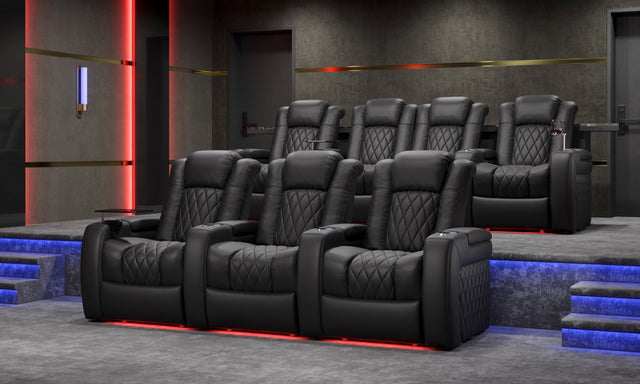
A contractor-built riser offers advantages a DIY build cannot easily replicate: integrated LED step lighting channels routed into the riser face, matched finish to the room's existing millwork, storage drawers or access panels under the deck, and a polished visual presentation that makes the riser look like a designed architectural feature rather than a built element.
What to Specify to Your Contractor
• Exact finished height (account for carpet and padding thickness — typically subtract 3/4 in for padding + carpet from the structural height).
• Exact platform depth (seat depth + full recliner extension + 6-inch margin).
• Blocking for electrical: where conduit exits the riser for power and USB at each seat position, and where the low-voltage runs for step lighting terminate.
• Step lighting channels: recessed LED strip channels routed into the riser face, 3 inches from the floor. The channel face should be flush or slightly recessed — proud channels are tripped over.
• Access panel: a hinged or removable section of the riser face to allow access to the wiring interior after completion.
• Load requirement: tell the contractor you need a minimum 50 lbs/sq ft floor load capacity.
Cost Comparison
• DIY materials: $300–600 for lumber, plywood, fasteners, and carpet installation supplies. Labor: your time.
• Contractor build: $2,000–5,000 depending on size, finish level, integrated lighting, and local labor rates. Finish carpentry with matched paint or stain and integrated LED channels is at the high end of this range.
• Permits: residential riser platforms are typically not permitted structures in Canadian jurisdictions, but verify with your local building department if the riser is attached to walls or if your municipality has specific basement renovation requirements.
5. Wiring the Riser: Power, USB, and Step Lighting

The riser interior is the most efficient wiring pathway in the theater room. Run all electrical and low-voltage wiring through the riser frame before the deck goes on. After decking, adding or modifying wiring requires cutting into the platform — an avoidable complication.
Power to Seat Positions
Theater recliners draw 1–2 amps each for power motors and USB charging. A 4-seat row at 2 amps per seat: 8 amps continuous. A dedicated 15A circuit to the seating wall is adequate and recommended — do not share the circuit with the AV rack or projector, which produce their own load spikes.
In Canadian construction, the wire standard for in-wall residential wiring is NMD90 (Loomex). Run 14-2 NMD90 from the electrical panel's dedicated circuit to a junction box inside the riser, then distribute to individual outlet boxes at each seat position recessed in the riser deck. Each outlet should be a standard 15A duplex recessed outlet mounted flush with the deck surface.
USB Conduit
Run 1/2-inch EMT conduit or flexible raceway from a central USB hub or power strip location to each seat position. Pull a drawstring through during construction — this allows USB cables to be replaced or upgraded later without opening the platform. USB-C is the current standard; plan conduit sizing to accommodate future connector changes.
Step Lighting
Low-voltage LED strip (12V DC) is the standard for riser step lighting. Run 18-gauge low-voltage wire from a central 12V transformer location to the step face channel. Use a transformer with at least 20% capacity overhead above the total LED strip load. Connect through a scene controller so step lighting can be dimmed independently from overhead lighting — step lighting at 5% is navigation brightness; at 100% it becomes a functional aisle light.
6. Choosing Seating for Your Riser Platform

The riser platform must be sized before you finalize your seat order, and the seat model must be confirmed before you finalize platform dimensions. This creates a planning dependency: you need to know the seat dimensions to build the platform, but the platform dimensions affect which seats work. Resolve this by confirming seat dimensions with the manufacturer early — before any construction begins.
Dimensions to Confirm from the Manufacturer
• Upright seat depth: measured from the front of the seat cushion to the back of the backrest at floor level.
• Full recliner extension: how far the footrest extends in front of the seat when at maximum recline. This is the most commonly missing measurement in product listings — request it specifically.
• Headrest height (fully upright): the total height from the floor to the top of the headrest. This drives the riser height calculation.
• Seat width: the outside-to-outside width of the seat including any armrest mechanism housing. Confirm for both individual seats and console sections.
Riser-Specific Seat Considerations
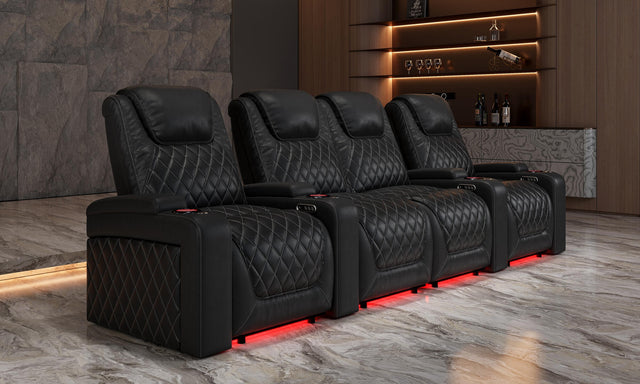
• Back-row seats on a riser are the premium viewing positions — they have the best sightlines and are often where guests with particular comfort preferences sit longest. Choosing a seat with heat and massage for the back-row riser position is a common upgrade that maximizes the value of the elevated platform.
• Avoid placing seats with very wide mechanical bases (some power recliner mechanisms add 4–6 inches of base width) on narrow platforms where the overhang could become a tripping hazard at the platform edge.
• Confirm delivery dimensions for each seat component (boxes are typically 30–36 in wide for residential theater seats) against the stairwell width if seating must be carried to a basement.
Frequently Asked Questions
How high should a home theater riser be?
Riser height depends on your specific front-row seat's headrest height and your ceiling clearance. The formula: measure from the floor to the top of the front-row headrest, add 6 inches, subtract 50 inches (the approximate seated eye level above the riser surface). The result is your minimum riser height. Most builds land between 8 and 12 inches. With an 8-ft ceiling, stay at 6–8 inches to maintain adequate headroom on the platform. With a 9-ft ceiling, 8–10 inches is comfortable.
What lumber size should I use for a riser frame?
For risers up to 10 inches tall, use 2×10 lumber (actual size 9.25 inches). For risers 10–14 inches tall, use 2×12 (actual 11.25 inches). These become the frame members, with the actual riser height achieved by the combination of frame depth, carpet padding, and carpet. Space interior support beams on 16-inch centers for spans up to 10 feet; reduce to 12-inch centers for heavier loads or longer spans. Use 3-inch wood screws for all fastening — nails are not adequate for a load-bearing platform.
How much does a home theater riser cost to build?
A DIY riser typically costs $300–600 for materials: dimensional lumber for the frame, 3/4-inch and 1/2-inch plywood for the deck, fasteners, construction adhesive, and carpet installation supplies. A contractor-built riser with integrated step lighting channels, matched finishes, and storage access panels typically runs $2,000–5,000+ depending on size and finish level. Neither estimate includes the cost of carpet or the step lighting fixtures themselves.
Can I build a riser on top of carpet?
Yes, but account for the carpet and padding thickness when calculating your finished riser height. Carpet plus padding is typically 3/4–1 inch. If your structural riser is 10 inches tall and you build it on top of 3/4-inch carpet, the finished height relative to the bare floor surface is 10 + 3/4 = 10.75 inches. This means the deck surface of the riser is slightly lower than the structural height suggests. Build your frame height to achieve the desired finished height after accounting for all layers above the floor.
Do I need a permit to build a home theater riser in Canada?
In most Canadian municipalities, a freestanding wooden platform (not attached to the structural walls or ceiling) does not require a building permit. However, any new electrical circuits — including the dedicated circuit to the seating wall — typically do require an electrical permit and inspection. Requirements vary by municipality; verify with your local building department before beginning electrical work. In Ontario, for example, electrical work requires a licensed electrician or a homeowner permit for work in your primary residence.
How do I add wiring to a riser I already built?
Adding wiring to an existing riser requires cutting into the deck and accessing the interior through the riser face. The cleanest approach: remove a section of carpet at the rear of the platform, cut a 4-inch access hole in the plywood deck, fish wire through the interior using a stiff wire fish tape, then patch and recarpet. Alternatively, if the riser was built with an access panel in the face, the interior is accessible without cutting. This is why planning wiring before decking is so strongly recommended — retrofitting costs significantly more time and effort.
Can I use the space under the riser for storage?
Yes. The riser interior is hollow (typically 8–12 inches of clear height above the subfloor, less the frame members). A carpentry contractor can install hinged drawers or access doors in the riser face to create usable storage. Common uses: storing extra blankets, gaming equipment, holiday decorations, or a separate AV component that benefits from being positioned at riser level. Ensure any storage built into the riser face does not interfere with the step lighting channel or the electrical conduit runs.
What if my riser height is wrong after I build it?
If the riser is too low: adding height means removing the deck, carpet, and potentially the top frame member to reframe at a taller height — significant work. Alternatively, adding a layer of 3/4-inch plywood to the existing deck raises the platform 3/4 inch per layer, which may be sufficient if the deficit is small. If the riser is too high: it is easier to reduce height than add it, but it still requires reframing. The most common cause of the wrong height is not measuring the actual front-row seat before building. Always order and receive the seating before finalizing riser construction.
References
- THX Ltd: THX Home Theater Certification Standards
- Rogue Engineer: Theater Riser Construction
- HTA Certified: Home Theater vs Media Room


