

In this article: A practical comparison of leather and fabric for home theater seating — covering how each material performs over time, which holds up better in Canadian climates, how maintenance requirements differ, and which material fits which type of theater room and household.
- Why Upholstery Material Matters More Than Most Buyers Realize
- Italian Leather: The Standard for Home Theater Seating
- Fabric Seating: Where It Works and Where It Doesn't
- Durability: How Each Material Ages Over Years of Use
- Comfort in Canadian Climates: Temperature and Humidity
- Which Material Is Right for Your Room?
- Frequently Asked Questions
The choice between leather and fabric for home theater seats is one of the most consequential decisions in the build process — more consequential than most buyers expect when they first sit down to configure their room. The material determines how the seats feel during a three-hour film in July, how they hold up after five years of regular use, how easy they are to clean after a spilled drink, and how they look after a decade. This guide covers all of those dimensions with specific attention to Canadian climate conditions.
The short answer most buyers arrive at: Italian leather is the dominant choice for dedicated home theaters, and there are good reasons for that. Fabric has legitimate advantages in specific situations. The full picture is worth understanding before you order.
Quick Takeaways
• Italian leather outperforms fabric in dedicated theaters over a 10+ year ownership period.
Durability, maintenance ease, and aging characteristics all favor leather in a room-specific theater setup. The higher upfront cost is recovered through longevity and lower cleaning effort over time.
• Fabric is the right choice for multi-purpose rooms with variable lighting.
Media rooms that double as family spaces, game rooms, or exercise areas benefit from fabric's softer feel from the first use, broader colour range, and lower upfront cost.
• Canadian winters make leather conditioning a necessity, not an option.
Forced-air heating reduces indoor humidity to levels that dry and crack unconditioned leather. A biannual conditioning routine is the baseline maintenance for leather seating in any Canadian province.
• Leather is easier to clean than fabric in practice.
Spills on leather are surface events that wipe clean. Spills on fabric penetrate the weave and require extraction cleaning to fully remove. For households with children or regular food and drink in the theater, leather's maintenance advantage is significant.
• Microfiber fabric is the highest-performing fabric option for theater use.
Among fabric choices, tightly woven microfiber (typically 200,000+ rub count) is the most durable and most stain-resistant. Looser weave fabrics are more prone to pilling, snagging, and absorbing odors over time.
1. Why Upholstery Material Matters More Than Most Buyers Realize

Theater seating is in direct contact with your body for every hour of use. The mechanical components — power recline, power headrest, massage motors — are covered by warranties and replaced if they fail. The upholstery is not replaceable in most cases; it is the material you live with for the life of the seat. It affects thermal comfort, ease of getting up and sitting down, how clean the seats stay over years, and how the room looks as both the seating and the room's design evolve.
The Factors That Actually Matter
Most buyers evaluate material on three dimensions: feel, looks, and price. The more complete evaluation includes:
• Thermal behavior — leather and fabric handle body heat and room temperature differently, and this matters significantly in Canadian climate conditions.
• Long-term durability — how the material wears with 3–7 sessions per week over 10 years is not visible in a showroom or product photo.
• Maintenance reality — the frequency and effort required to keep the material in acceptable condition affects the ownership experience throughout.
• Household compatibility — the material that works for a couple who rarely eats in the theater is different from what works for a family with three children and a dog.
• Allergen considerations — fabric absorbs dust, pet dander, and allergens more readily than leather, which can be a meaningful factor for households with sensitivities.
2. Italian Leather: The Standard for Home Theater Seating

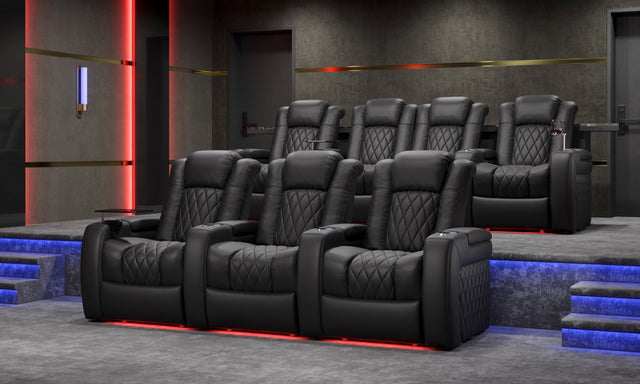
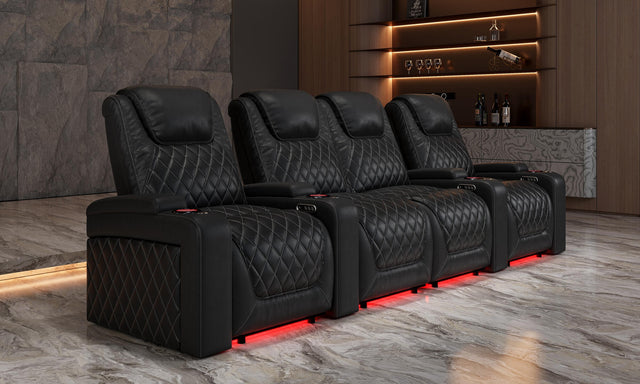
Italian leather became the standard material for premium home theater seating because it performs well in the specific conditions a theater room creates: low ambient light, extended sitting sessions, temperature-controlled environments, and the expectation that the material will age gracefully over many years of regular use.
Types of Leather Used in Theater Seating
Not all leather is equivalent. The main categories used in theater seating:
• Top-grain leather: the upper layer of the hide, lightly sanded and surface-treated. Durable, consistent, easier to maintain than full-grain. Used in Valencia's Nappa 9000 and 11000 grades.
• Semi-aniline leather: dyed with translucent aniline dyes rather than opaque pigment coatings, allowing natural hide characteristics to show. Softer and more breathable than top-grain. Used in Valencia's Nappa 20000 grade.
• Bonded leather: manufactured from leather scraps and binding agents. Not genuine leather. Tends to peel and delaminate within 3–5 years of regular use. Not used in Valencia products but common in lower-priced theater seat brands.
• PU (polyurethane) synthetic: leather-like appearance but no genuine hide content. More affordable; does not breathe and does not age like leather. Used in some budget theater seating.
Leather's Core Advantages for Theater Use
• Wipes clean: surface spills do not penetrate; a damp cloth resolves most incidents immediately.
• Does not absorb odors: fabric absorbs food smells and body odors over time; leather does not under normal conditions.
• Ages well: genuine leather develops patina over time rather than degrading; a well-maintained leather seat improves in character over years.
• Allergen-resistant: leather does not trap dust mites and pet dander the way fabric weaves do.
3. Fabric Seating: Where It Works and Where It Doesn't

Fabric theater seating has a legitimate use case. The assumption that leather is always the better choice is not accurate for every household or every room type. Understanding where fabric performs well and where it underperforms makes the decision cleaner.
Where Fabric Works Well
• Multi-purpose media rooms: a space used for gaming, family movie nights, sports viewing, and casual lounging benefits from fabric's soft, immediately comfortable feel and its tolerance for variable use patterns.
• Rooms with variable lighting: fabric's visual texture looks good in both light and dark conditions; leather can look cold or stark in brightly lit rooms.
• Colour and pattern variety: fabric offers a far wider range of colours and textures than leather. Households designing around a specific interior palette benefit from the additional options.
• Lower initial investment: fabric theater seating typically costs less upfront than equivalent leather configurations, making it accessible at budget points where leather is not available.
Where Fabric Underperforms
• Spills and staining: liquid penetrates fabric weaves and requires extraction cleaning to fully remove. A spilled glass of red wine or a dropped bowl of popcorn becomes a cleaning project rather than a wipe-down.
• Odor absorption: fabric upholstery absorbs food smells, pet odors, and body odors over time. In a room used regularly for eating and drinking, this accumulates.
• Long-term pilling and wear: fabric fibers break down with friction over years of use, producing pilling on the armrests and seat edges — visible in under 5 years on most fabrics with regular use.
• Allergen accumulation: fabric traps dust mites, pet dander, and other allergens in the weave, requiring more frequent deep cleaning for allergy-sensitive households.
The Best Fabric for Theater Seating
If fabric is the right choice for your room, specify tightly woven microfiber with a high rub count (200,000+ double rubs on the Martindale or Wyzenbeek scale). This grade of fabric is significantly more durable than the loosely woven polyester blends common in lower-priced seating. Microfiber also cleans more easily than open-weave fabrics and does not pill as aggressively.
4. Durability: How Each Material Ages Over Years of Use

| Factor | Italian Leather | High-Quality Microfiber Fabric |
|---|---|---|
| Expected lifespan | 10–15+ years with conditioning | 7–10 years with proper care |
| Surface wear pattern | Develops patina; improves in character | Pilling and fiber breakdown at friction points |
| Spill response | Surface wipe; no penetration | Penetrates weave; requires extraction |
| Odor absorption | Minimal under normal conditions | Absorbs food and body odors over time |
| Cleaning frequency | Wipe monthly; condition twice yearly | Vacuum weekly; deep clean quarterly |
| Allergen resistance | High — does not trap allergens | Low — traps dust and dander in weave |
| Appearance after 10 years | Richer patina; slightly more supple | Visible fiber wear at contact points |
5. Comfort in Canadian Climates: Temperature and Humidity

Canadian climate conditions create specific material performance considerations that do not apply in more temperate climates. The two key factors are winter temperature and seasonal humidity variation.
Temperature: Cold Leather in Winter
Leather seats that have been sitting in a cool basement or unheated room feel cold when you first sit down. This is the most frequently cited comfort complaint about leather in Canadian homes. The reality: Italian leather reaches body temperature within 5–10 minutes of sitting, after which it feels warmer than fabric for extended sessions because it does not trap heat the same way fabric does. The initial cold is a startup cost; the ongoing thermal comfort is in leather's favor for multi-hour viewing sessions.
Practical mitigation: set the theater room temperature 30–60 minutes before use in winter, or choose seating models with built-in heating (such as the Tuscany Executive) that resolve the cold-start problem entirely.
Humidity: The Critical Factor for Leather Longevity
Forced-air heating in Canadian homes reduces indoor humidity to 20–30% during winter months in many provinces. At this humidity level, unconditioned leather dries and eventually cracks at stress points — armrest edges, headrest backs, and footrest creases are the first areas affected. The solution is straightforward: condition leather twice per year (fall and spring), and consider supplemental humidification in the theater room to maintain 40–50% relative humidity through the heating season. Leather that is conditioned regularly performs well in Canadian climates indefinitely; leather that is not conditioned degrades visibly within 3–5 years regardless of the initial quality.
Fabric is not affected by low humidity in the same way. The tradeoff is that fabric in high-humidity environments (summer, coastal BC) absorbs moisture and can develop odors or mildew if ventilation is inadequate. For fabric seating in Canadian basements, active dehumidification in summer is the equivalent maintenance task.
6. Which Material Is Right for Your Room?

The decision framework is straightforward once the room type and household situation are defined.
Choose Italian Leather When
• The room is a dedicated or semi-dedicated home theater — not a general family room.
• The household includes food and drinks in the theater and ease of cleaning matters.
• Long-term ownership (10+ years) is the intention — leather rewards this time horizon.
• Anyone in the household has allergies to dust mites or pet dander.
• The room's visual design calls for a premium, cohesive aesthetic.
Choose Fabric When
• The room is a multi-purpose media room, not exclusively a theater.
• The interior design calls for a specific colour or texture that is only available in fabric.
• The household prefers the soft, immediately comfortable feel of fabric from the first use.
• Budget is a primary constraint and fabric makes a specific configuration accessible.
• The cold-start feeling of leather in winter is an unacceptable tradeoff for the household.
Mixed Configurations
Some buyers choose leather for the primary seat positions (most-used seats in the center of the row) and specify a different material for supplementary or overflow seating at the sides or in a second row. This approach combines leather's longevity advantage at the primary viewing positions with fabric's cost advantage for less frequently used positions.
Frequently Asked Questions
Is leather or fabric better for home theater seats?
Leather is the better choice for most dedicated home theaters. It is easier to clean, does not absorb odors, ages well over 10+ years, and performs better in the thermal conditions of an extended movie session. Fabric has advantages in multi-purpose rooms — it's immediately soft, comes in more colours, and costs less upfront. The right answer depends on how the room is used: dedicated theater favors leather; casual media room can go either way.
Does leather feel cold in a Canadian winter home theater?
Cold leather at the start of a session is a real phenomenon in Canadian homes, especially in basement theaters or rooms that are not kept at full temperature between sessions. The leather reaches body temperature within 5–10 minutes of sitting. The practical solutions: warm the room 30–60 minutes before use, or choose seating with built-in heating zones (such as the Tuscany Executive) which eliminate the cold-start problem entirely. Once at temperature, Italian leather is more comfortable for extended sessions than fabric because it does not retain body heat.
How do I clean fabric theater seats?
For routine maintenance, vacuum fabric seats weekly with an upholstery attachment to remove dust and loose debris. For spills, blot immediately with a clean cloth — do not rub. Use a fabric upholstery cleaner appropriate for the specific fabric type; test in an inconspicuous area first. For deep cleaning, a portable upholstery extractor (steam cleaner) is more effective than spray-and-wipe cleaners at removing embedded stains and odors. Frequency of deep cleaning depends on use — quarterly is appropriate for regular use with food and drinks in the room.
How long does leather theater seating last compared to fabric?
Well-maintained Italian leather theater seating lasts 10–15+ years. High-quality microfiber fabric typically lasts 7–10 years before visible wear at friction points becomes significant. Lower-quality fabrics and bonded "leather" wear out faster — bonded leather (leather scraps bound with adhesives) commonly begins peeling within 3–5 years. The longevity advantage of genuine Italian leather is one of the primary reasons it dominates the premium home theater seating category despite higher upfront cost.
Which is easier to maintain: leather or fabric?
Leather is easier to maintain for most households. Routine cleaning is a damp cloth wipe; spills resolve immediately; conditioning is required twice per year. Fabric requires more frequent vacuuming, deeper cleaning for spills, and periodic professional or machine extraction to maintain freshness. The exception is leather in very dry Canadian winters without supplemental humidity — unconditioned leather in a dry forced-air heating environment requires conditioning to prevent cracking. With that maintenance, leather's overall care burden is lower than fabric's over a 10-year ownership period.
Is fabric theater seating good for people with allergies?
Fabric is not ideal for allergy-sensitive households. Fabric weaves trap dust mites, pet dander, pollen, and other allergens more readily than leather surfaces. Regular vacuuming reduces accumulation but does not eliminate it. Leather is significantly better for allergy management: its smooth surface does not trap allergens, and wipe cleaning removes what accumulates on the surface. If someone in the household has allergies to dust mites or pet dander, leather is the recommended choice for upholstered seating in a frequently used room.
Can fabric theater seats be professionally cleaned?
Yes. Professional upholstery cleaning services use hot water extraction or dry cleaning methods appropriate to the specific fabric type. Before booking, confirm that the cleaning method is compatible with your fabric — some fabrics are water-sensitive (check the manufacturer's cleaning code: W for water-based, S for solvent, SW for either, X for vacuum only). Annual professional cleaning is worth considering for fabric theater seating in rooms with heavy use and food or drink consumption. It extends the appearance and freshness of the fabric significantly compared to surface cleaning alone.
What fabric is most durable for home theater seating?
Tightly woven microfiber with a high double-rub count (200,000+ on the Martindale or Wyzenbeek scale) is the most durable fabric for theater seating. It resists pilling, cleans more easily than open-weave fabrics, and holds its appearance longer under regular use. Avoid loosely woven chenille, velvet, or open-structure weaves for primary theater seating — they snag, pill, and show wear significantly faster than microfiber. Performance fabrics with stain-guard treatments (such as Crypton or Sunbrella) offer additional spill resistance while retaining a soft hand-feel.
References
- Consumer Reports: Biggest Mistakes to Avoid When Buying a Couch
- Rolford Leather: The Beginner’s Guide to Leather Grades and Quality


